Writing on the Mountain: The Teotihuacan Glyphs of Chalcatzingo
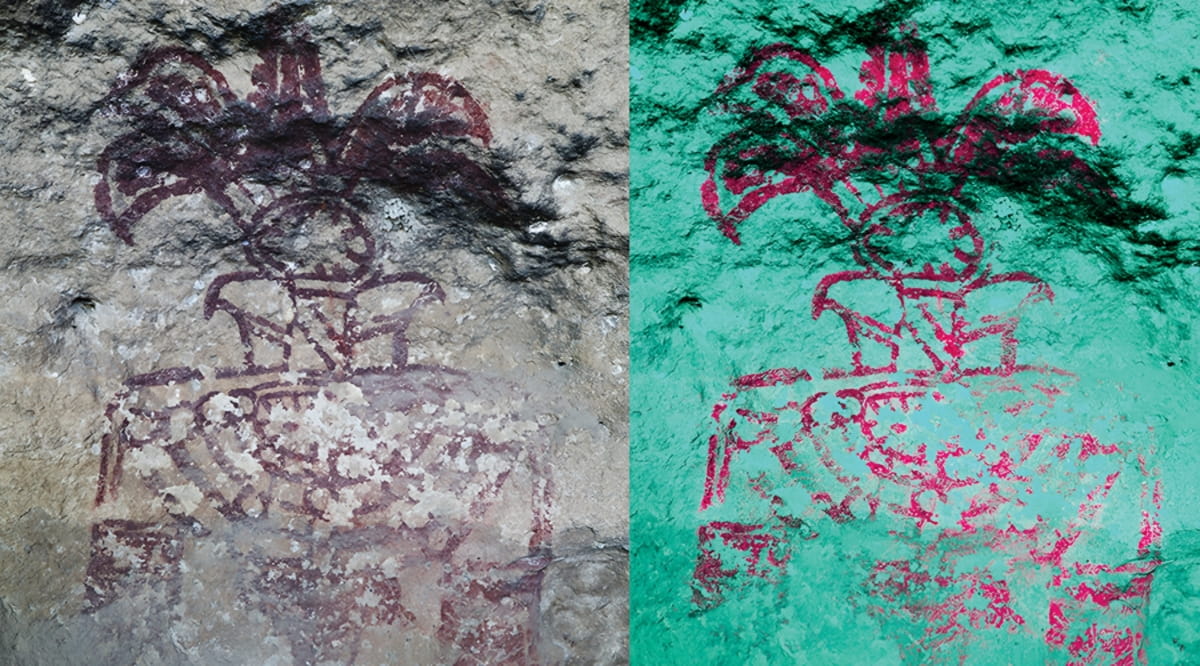
Three dark-red painted compositions survive on the back wall of a rockshelter only 7.4 square metres in area, partway up the western face of Cerro Delgado at Chalcatzingo in Morelos. One has lost almost half its painted surface to weathering. Another combines a beaded necklace, cloth and an atlatl dart. The third, more than a metre wide, frames a low bedrock shelf beneath a ceiling blackened by fire. When Christophe Helmke and colleagues returned to Cave 19 in August 2022, digital enhancement made the deteriorated brushwork considerably easier to read. What emerged was not another group of the Formative-period images for which Chalcatzingo is famous. The signs belong to the visual and glyphic repertoire of Teotihuacan, several centuries later, and two of them behave like writing.
That distinction deserves care. The new study does not reveal an unknown Mesoamerican script, nor does it demonstrate that cave paintings generally were a form of writing. It adds three compositions from an unusual archaeological context to a corpus that specialists have spent decades trying to define. The larger argument is more consequential: Teotihuacan, long described as an urban state conspicuously lacking the extensive texts known from the Classic Maya world, possessed a structured graphic system capable of recording linguistic information. Cave 19 matters because its glyphs occur far from the metropolis, in a landscape whose ritual importance was already very old when Teotihuacan reached its political height.
A Classic-Period Text in a Formative Sacred Landscape
Chalcatzingo lies about 90 kilometres south-east of Mexico City, between Cerro Chalcatzingo, at 1,623 metres above sea level, and Cerro Delgado, at 1,486 metres. Archaeologists know the site principally for its Middle and Late Formative occupation and its extensive Olmec-style monumental imagery, conventionally dated to about 900–500 BC. More than 50 carved panels are now documented. They include complex compositions involving caves, rain, maize, felines, birds and supernatural beings, cut directly into exposed rock surfaces.
Those monuments made Chalcatzingo central to arguments about what the label Olmec means outside the Gulf Coast heartland. Excavations undertaken in the 1970s by the Chalcatzingo Archaeological Project demonstrated that the settlement was not simply an imported Olmec enclave. Its architecture, domestic remains and material culture belonged to a local community participating in much wider networks of exchange and imagery. The mountain itself formed part of that cultural landscape. Carved caves, rain clouds and vegetation turned natural rock surfaces into elements of a constructed sacred geography.
Cave 19 belongs to a much later episode. It lies approximately 330 metres from the centre of Chalcatzingo, about one-third of the way up Cerro Delgado's 110-metre-high western face. Calling it a cave is generous. The shelter measures 5.43 metres north to south, reaches only 2.24 metres in maximum depth, and has a dripline between 1.46 and 1.85 metres high. Access today requires approaching from the eastern side of the hill and abseiling down the western escarpment. Cut footholds and rough steps suggest that ancient visitors may instead have climbed from below, perhaps using ladders or scaffolding.
The paintings were not newly discovered in 2022. They had been documented by Anne Apostolides during earlier work on Chalcatzingo's painted art and published in David Grove's 1987 Ancient Chalcatzingo. Their chronological and cultural position, though, remained poorly understood. The renewed investigation places them within a much more developed body of research on Teotihuacan notation and writing.
There was already material evidence for Classic-period activity in this part of Morelos. Test excavations by Román Piña Chan in the 1950s recovered diagnostic Teotihuacan-related ceramics at Chalcatzingo. Kenneth Hirth's regional settlement survey subsequently documented a network of Classic-period occupations farther south. San Ignacio, 13 kilometres from Chalcatzingo, was the largest: a substantial settlement with rectilinearly arranged mound groups, domestic platforms, larger civic or ceremonial architecture and a ballcourt. Thin Orange pottery, cylindrical tripod vessels, Basin of Mexico obsidian and other material linked the settlement to the Teotihuacan sphere. Cave 19 therefore did not exist in geographical isolation from communities participating in that network.
Recovering Three Fading Compounds
The physical evidence in Cave 19 is modest. Scattered ceramic sherds remained on the floor in 2022, along with a small fragment of a metamorphic stone metate. At the rear is a bedrock shelf approximately 1.45 metres wide and 0.52 metres deep. Fire-clouding blackens the wall and ceiling above it. Immediately beside and above this feature are the three painted compositions.
The researchers measured and plotted the paintings and photographed them with a Canon EOS M50 camera. RAW image data were then processed using colour-channel manipulation in Adobe Photoshop and several DStretch routines, including LAB-based Red Enhance and Decorrelation Stretch. This is enhancement rather than reconstruction: the software increases contrasts between surviving pigment and rock, allowing faint painted traces to become more legible. It cannot restore portions that erosion has physically removed.
The paint consists of dark-red pigment, probably haematite, applied in controlled lines with a brush. Glyph 1 measures 293 by 282 millimetres; glyph 2 is 384 by 541 millimetres. Glyph 3 is much larger, 1.02 metres wide and 0.60 metres high. The compositions differ from much of Chalcatzingo's other painted rock art, which includes comparatively schematic faces, geometric forms and other designs of uncertain date.
Preservation is particularly important for glyph 1. Its left side extended beyond the shelter's dripline and has weathered away. What survives includes a stylised mountain sign and part of what the authors reconstruct as a symmetrical tri-mountain composition. Scrolls emerge from an open mouth. In the Teotihuacan signary, comparable scrolls encode speech or song. Helmke and colleagues consequently interpret the compound as a toponym, or place-name: Singing Mountain.
The reading is not arbitrary, but neither is it equivalent to reading a securely deciphered Maya inscription. A comparable place-name occurs in Teotihuacan murals, and a hill near Chalcatzingo was historically known by the Nahuatl name Cuicatepec, also meaning Singing Mountain. The authors propose that the Cave 19 glyph names Cerro Delgado itself. If that identification is correct, the same locality may also be referenced in the murals of Patio 1 at the Tetitla compound at Teotihuacan, where figures carrying incense pouches participate in a ritual procession accompanied by glyphic compounds.
This is one of the study's strongest interpretive links, but the chronology needs to be kept visible. The Cave 19 paintings are stylistically assigned to approximately AD 350–550; the Nahuatl toponym is documented from a much later linguistic setting. The correspondence is evidence for a potentially durable place-name tradition, not proof that the Classic-period inhabitants of Teotihuacan spoke Nahuatl.
A Warrior Title and a Fire-Blackened Shelf
Glyph 2 is built from a different vocabulary. A large beaded necklace lies above a piece of cloth interpreted as a cloak or tippet, while an upright dart passes through the composition. Its point and feathered fletching identify it as the type of projectile thrown with an atlatl. All three elements have parallels in Teotihuacan imagery and writing, particularly in compositions associated with martial equipment.
The authors interpret the compound as a military title, possibly naming a warrior order. That reading is less secure than the identification of its constituent signs. Comparable arrangements have previously been interpreted as warrior bundles or martial trophies. Later Nahuatl poetic traditions combine terms for spear-throwers and necklaces in expressions of military prestige, providing a useful analogy, but a later analogy cannot by itself supply the Classic-period reading. What the painting securely demonstrates is that the painter combined recognised Teotihuacan signs associated with martial regalia. Precisely what spoken title a contemporary viewer attached to the compound remains unresolved.
Glyph 3 requires another distinction. The researchers do not classify it as linguistic writing. It is a rectangular painted frame decorated with five-pointed stars and positioned directly over the bedrock shelf. Comparable starry frames occur on Teotihuacan polychrome and incised vessels and on elaborate theatre-style censers, where they represent awnings or architectural settings associated with ritual display and the commemoration of warriors.
Here archaeological context becomes unusually useful. The wall and ceiling above the shelf are visibly fire-blackened. Burning therefore occurred at this precise location. What was burned is unknown. No censer, human remains, funerary bundle or stratified combustion deposit survives that could settle the question. Helmke and colleagues propose a pyrolytic rite, possibly involving incense or the cremation of a funerary bundle associated with warrior commemoration. The first part of that argument rests on direct physical evidence for fire; the second depends on iconographic comparison with Teotihuacan ritual practice.
This is exactly the point at which an attractive reconstruction can outrun the archaeological record. A fire-blackened ritual shelf framed by martial imagery is a coherent association. A cremated warrior is a hypothesis. Exposure has removed the deposits that might once have distinguished between incense burning, cremation and other uses of fire.
Was Teotihuacan Really a State Without Writing?
The Cave 19 study enters a much older debate. Teotihuacan was one of the largest cities in the ancient Americas, covering roughly 20 square kilometres at its height and exercising cultural and political influence far beyond the Basin of Mexico. Yet its textual record looks nothing like that of Classic Maya centres. There are no long dynastic inscriptions comparable to those at Tikal, Palenque or Copán, no securely reconstructed king lists, and few extended sequences of glyphs.
This absence shaped twentieth-century interpretation. James Langley described a Teotihuacan notational system and graphic conventions; other scholars preferred terms such as emblematic glyphs. The problem was partly structural. Teotihuacan texts are short. A single compound can stand beside a figure or within a mural composition, leaving little internal syntax for epigraphers to analyse. Images and graphemes are also tightly integrated, making the boundary between iconography and writing difficult to establish.
Research since Karl Taube's 2000 study The Writing System of Ancient Teotihuacán has changed the balance of evidence. Christophe Helmke and Jesper Nielsen's 2021 reassessment identified a corpus containing toponyms, personal names, titles, calendrical information and verbal expressions. They estimated a sign inventory approaching 120 graphemes and argued that the system was logo-phonetic: predominantly logographic signs representing words or concepts were combined with signs carrying phonetic information. That places Teotihuacan within the broader family of Mesoamerican writing traditions without making it identical to Maya hieroglyphic writing.
Cave 19 strengthens that case because the signs are arranged in compounds that recur elsewhere and perform functions expected of writing. A mountain sign qualified by speech or song scrolls operates as a place-name; martial objects combine in a conventionalised compound that probably encoded a title. The third composition also demonstrates why caution is necessary. It belongs to the same visual environment but is treated by the authors as iconography rather than a logogram. Teotihuacan communicative practice used writing and image together, and modern attempts to force every painted form into one category would distort that system.
Decipherment nevertheless remains incomplete. Identifying a sign's function is not the same as recovering its ancient pronunciation. The language, or languages, represented by Teotihuacan writing remain debated. Recent linguistic work has narrowed the problem and proposed possible affiliations, but Cave 19 does not provide a bilingual inscription or a long enough sequence to resolve it. Its importance lies in expanding the comparative corpus.
Why Teotihuacan Returned to Chalcatzingo
The chronological separation between Chalcatzingo's best-known monuments and Cave 19 is close to a millennium. The great Formative carvings belong mainly to about 900–500 BC; the Cave 19 activity is placed in the fourth to sixth centuries AD. The Teotihuacan visitors were therefore engaging with a landscape already carrying an ancient monumental history.
The immediate temptation is to describe this as cultural continuity. The archaeological evidence does not require it. A sacred landscape can be rediscovered, appropriated and reinterpreted without an unbroken transmission of ritual knowledge. What persisted was the physical setting: two conspicuous volcanic hills, caves and rockshelters, monumental carvings and a landscape already modified by earlier ceremonial activity.
Teotihuacan's presence outside its metropolitan core was equally variable. Archaeology has documented Teotihuacan material, enclaves and political interventions across central Mexico and into Oaxaca, the Maya lowlands and the Pacific regions of Chiapas and Guatemala. Some relationships involved exchange or migration; others had stronger political or military dimensions. The famous events recorded in Maya inscriptions around AD 378 demonstrate that Teotihuacan connections could intersect directly with dynastic politics. It would be a mistake to make every distant Teotihuacan object evidence for conquest.
Eastern Morelos had economic value. Its fertile valleys and routes towards Guerrero and Oaxaca made settlement strategically useful, and the network documented by Hirth provides a plausible population base for the Cave 19 activity. Chalcatzingo itself may have attracted visitors for another reason. Its monumental landscape was associated with caves, mountains, agricultural fertility and origins long before the Classic period. If the Singing Mountain identification is correct, the Tetitla murals at Teotihuacan may even preserve a reference to journeys or rituals connected with this locality.
That would turn the Cave 19 paintings into evidence not merely for the geographical distribution of a script, but for movement between a metropolis and a provincial sacred place. Writing was carried into the landscape and placed where ritual actions were performed. The distinction matters. Scripts do not spread independently of people, institutions and practices.
The safest reading of Cave 19 is therefore narrower than the popular claim that cave paintings have revealed a lost Mesoamerican writing system, but archaeologically more useful. Two deteriorating painted compounds can be integrated with an established Teotihuacan signary; a third composition belongs to a ritual iconographic programme centred on a place where fire was repeatedly or intensely used. Their stylistic date accords with independent evidence for Teotihuacan-related settlement in eastern Morelos. Together they show that Teotihuacan graphic communication operated outside the metropolis and in a setting very different from palace walls, apartment compounds or decorated ceramics.
What remains unresolved is arguably more interesting than assigning the paintings a simple label. We still cannot read Teotihuacan writing with anything approaching the fluency achieved for Classic Maya texts. We do not know precisely what language its scribes encoded. The Singing Mountain reading is persuasive but not independently proven, and the warrior interpretation of the second compound remains dependent on iconographic comparison. Nor can the blackened shelf tell us who or what was burned there. Cave 19 nevertheless adds something the field badly needs: another text in archaeological context. With a corpus this small, every securely documented sign, spatial association and repeated compound constrains future decipherment. The mountain has not yielded a Rosetta Stone. It has supplied a few more pieces of a writing system that archaeologists are finally learning how to recognise.
Selected Sources and Further Reading
- Helmke, C., Nielsen, J., Meza Rodríguez, C. & Córdova Tello, M. (2026). Painted Teotihuacan glyphs of Cave 19, Chalcatzingo, Morelos, Mexico. Antiquity, First View, 1–19.
- Helmke, C. & Nielsen, J. (2021). Teotihuacan Writing: Where are We Now? Visible Language, 55(2), 29–73.
- Nielsen, J. & Helmke, C. (2011). Reinterpreting the Plaza de los Glifos, La Ventilla, Teotihuacan. Ancient Mesoamerica, 22, 345–370.
- Langley, J.C. (1991). The Forms and Usage of Notation at Teotihuacan. Ancient Mesoamerica, 2, 285–298.
- Cowgill, G.L. (2015). Ancient Teotihuacan: Early Urbanism in Central Mexico. Cambridge: Cambridge University Press.
- Grove, D.C. (ed.) (1987). Ancient Chalcatzingo. Austin: University of Texas Press.
- Pharao Hansen, M. & Helmke, C. (2025). The Language of Teotihuacan Writing. Current Anthropology, 66, 705–739.