Juukan’s scavenged bones place human camps within the Pilbara’s ancient food web
Source: “New fossils show Tasmanian devils lived with people in outback Western Australia 45,000 years ago” — The Conversation ↗, 10 September 2026
Archaeonews Summary
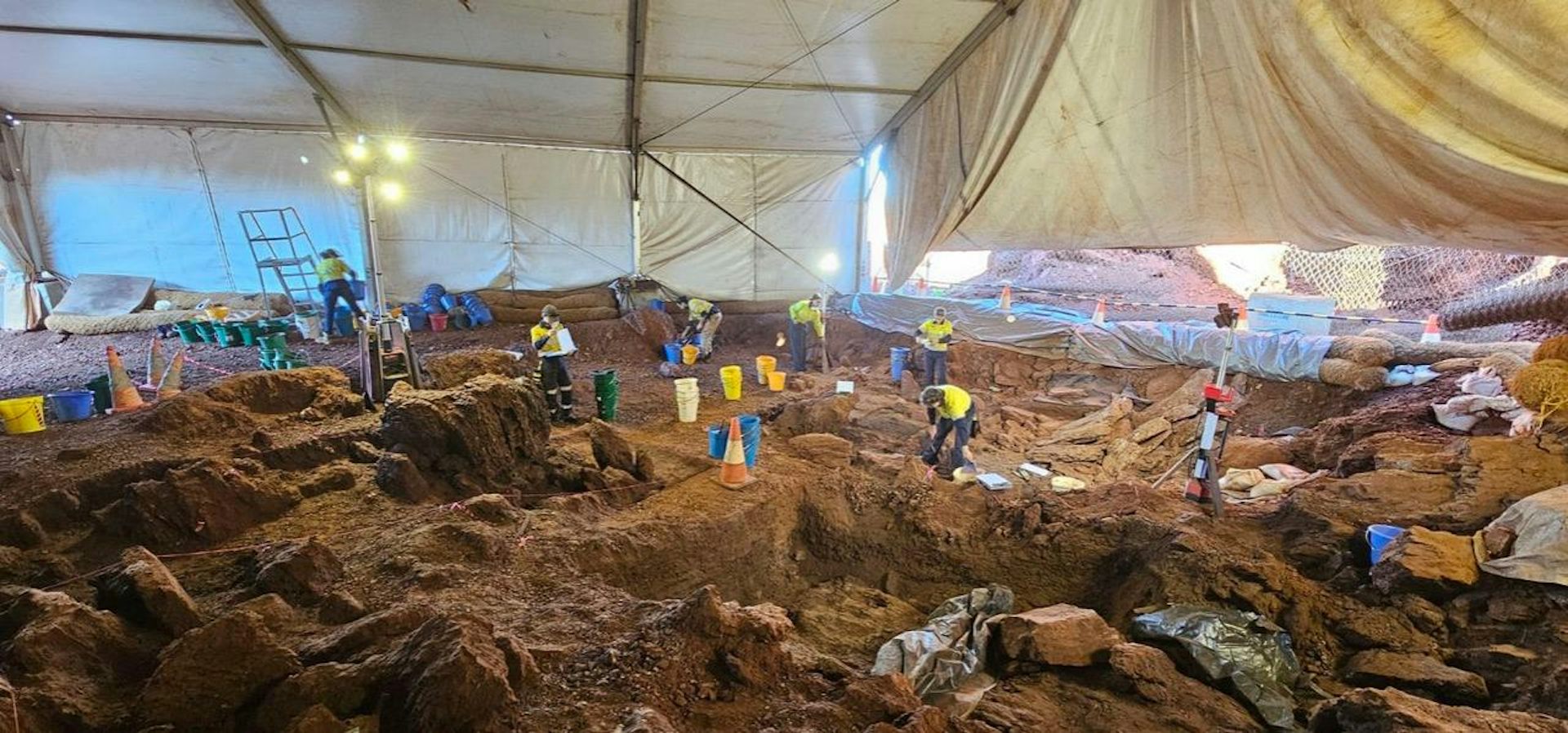
A jaw fragment and a tooth fragment from Juukan 2 rockshelter provide the first unequivocal fossil evidence of Tasmanian devils in the Pilbara, Western Australia. The site lies near Tom Price, on Puutu Kunti Kurrama Country. UNSW palaeontologist Timothy Churchill and colleagues, working with Traditional Owners, report the excavated remains in Archaeology in Oceania.
The jaw comes from deposits dated to 6,900–7,300 years ago; the tooth from deposits dated to 42,500–47,100 years ago. These are contextual ages, not direct dates on the fossils. Earlier research established the shelter’s chronology using radiocarbon, luminescence dating, which measures when sediment was last exposed to light, and statistical modelling. Analysis of other animal bones found tooth marks and digestive damage consistent with devils, supporting the team’s interpretation that they repeatedly scavenged at the shelter.
Why It Matters
The geographical correction is specific: devils were already known from southern Western Australia, but the Pilbara lacked unequivocal fossil confirmation. More consequential for archaeology is the suggestion that food discarded by people helped sustain a scavenger community. Human occupation could shape local animal ecology without domestication or deliberate feeding.
This also affects how the bone assemblage should be read. The site’s 2024 study documented increased bone and stone artefact discard during the last 3,500 years, interpreted as more frequent human use. The new findings underline that surviving bones also reflect what scavengers consumed or damaged. Food refuse is a record of several agents’ activities, not simply a tally of human meals.
The findings are reported in a peer-reviewed journal, although the authors’ accessible account leaves important limits clear. Devil-like damage supports scavenging but does not establish uninterrupted coexistence. Nor do these fossils demonstrate that competition with dingoes caused mainland extinction.