When Gods Judged Gods: Divine Councils in Mesopotamia and Ancient Egypt
A divine assembly cannot settle a dispute. Its members disagree, its presiding authority favours one candidate, and a letter must be sent to another goddess for advice. The question is who should inherit a throne. The participants are gods, but their difficulties concern recognition, competing qualifications and the authority to decide.
This scene belongs to the Egyptian narrative known as The Contendings of Horus and Seth. Its divine world offers a revealing comparison with Mesopotamian compositions in which Enlil can be sanctioned by an assembly and Marduk receives kingship through collective acknowledgement. The similarity raises a historical question: are we seeing transmitted traditions, comparable ways of imagining government, or some combination of the two?
The answer requires distinguishing evidence of contact from evidence of borrowing. Objects can travel without carrying an entire theology. A deity can cross a political border without replacing the receiving society’s gods. Two narratives can confront similar problems without descending from the same story. These distinctions make comparison more useful, because they allow us to identify precisely what the surviving evidence supports.
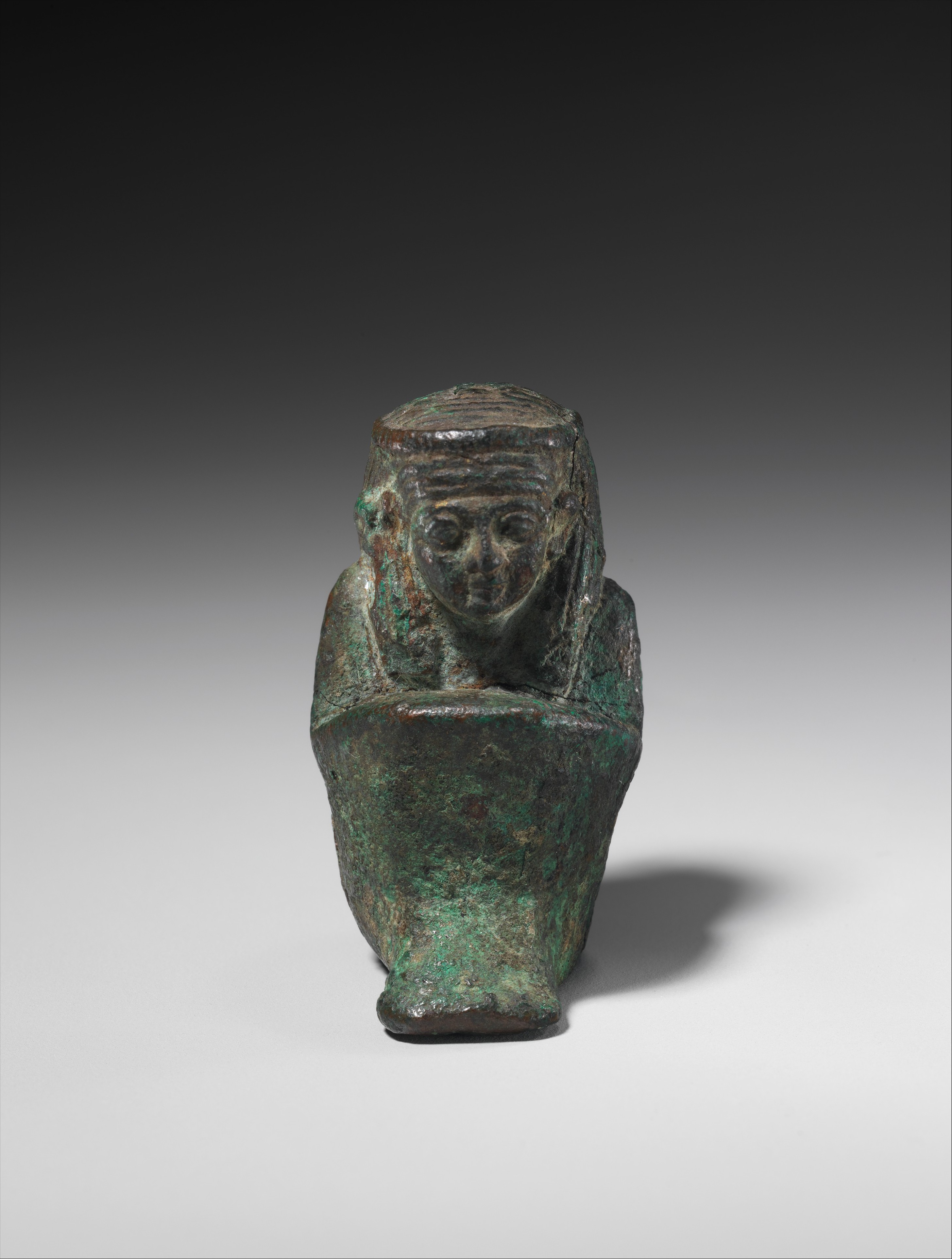
Featured image: Maat, copper-alloy figure with traces of gilding, approximately 1080–332 BCE. The Metropolitan Museum of Art, object 10.130.1302. Gift of Helen Miller Gould, 1910. Image: The Metropolitan Museum of Art, Public Domain. The figure illustrates the Egyptian personification of truth, justice and equilibrium; it is not a depiction of the council in The Contendings of Horus and Seth.
A succession dispute among Egyptian gods
The principal manuscript of The Contendings of Horus and Seth, Papyrus Chester Beatty I, belongs to Egypt’s Twentieth Dynasty. The narrative occupies sixteen pages of its recto. Alan H. Gardiner published an edition and translation in 1931, and the Bibliotheca Alexandrina provides an accessible English rendering. The manuscript is evidence for a particular literary telling, rather than a complete account of everything Egyptians believed about these gods. [1] [2]
Horus claims the office of his father Osiris. Seth invokes his strength and his service in defending the solar god, while an argument supporting his claim also appeals to his seniority within the divine family. The dispute therefore brings hereditary succession, family seniority and demonstrated capacity into competition. The council does not immediately reconcile these claims, and its deliberations include disagreement with the solar authority presiding over the proceedings. [1]
The interpretation proposed here is that the narrative makes legitimate rule a problem requiring more than the identification of the strongest participant. Strength is a claim that can be argued, but its relevance remains contestable. Descent and seniority also require interpretation: which relationship should take precedence, and why? A candidate’s position has to become an accepted settlement.
This is where the comparison with human institutions becomes illuminating but also dangerous. Words such as council, hearing and succession help identify the narrative’s concerns. They do not establish that it preserves the constitution of an Egyptian court. Literary gods can exaggerate, disrupt or ridicule procedures familiar to an audience without giving us a faithful administrative description.
My reading is that the prolonged disagreement exposes a gap between knowing that order should exist and agreeing on how to produce it. A divine setting does not eliminate the problem of judgment. It allows the story to explore that problem through actors whose own authority is part of the dispute.
Why the council writes to Neith
When the participants seek Neith’s judgment, her answer recommends awarding Osiris’s office to Horus while providing compensation for Seth. The letter is read before the assembly and receives collective approval, yet resistance from the solar ruler means that the conflict continues. Advice, agreement and implementation do not coincide automatically. [1]
This sequence is particularly relevant to the idea of powers above the gods. Neith’s intervention can look like an appeal beyond the immediate circle of decision-makers. It does not establish that she belongs to a separate species or level of existence. She is another divine authority whose position gives her judgment weight within the narrative.
My interpretation is that the letter distinguishes authority from immediate presence. Someone outside the current deliberation can contribute a judgment that those present cannot simply ignore. That is different from discovering a hidden ruler who controls every participant.
The communication itself also matters. A letter has a sender, a recipient and a moment when its contents are presented. The narrative turns consultation into an event. For the reader, that makes visible the distance between asking for an answer and obtaining compliance with it.
Later, correspondence with Osiris introduces another intervention into the proceedings, and the narrative eventually ends with Horus installed in his father’s position while Seth receives a place with the solar god. The settlement accommodates the defeated claimant within the resulting arrangement. [2]
My further inference is that resolving the dispute involves assigning positions as well as choosing a victor. The outcome does not require every rival power to disappear. Authority becomes workable through an arrangement of relationships, even after a long failure to agree.
Enlil’s sanction and Marduk’s recognition
A Sumerian comparison comes from Enlil and Ninlil. After the encounter between the two deities, an assembly has Enlil arrested and he leaves the city as ritually impure. The same composition later praises his sovereignty and the enduring authority of his words. The Oxford translation preserves manuscript variants in the expulsion passage, but the combination of collective sanction and exalted status remains evident. [3]
The resemblance to the Egyptian narrative concerns the possibility of disagreement and constraint within the divine community. The situations themselves differ. Enlil’s episode concerns sanction and departure; the Egyptian dispute concerns competing claims to succession. Treating them as interchangeable would remove the features that make each useful evidence.
The Babylonian Enuma Elish offers a third arrangement. Before Marduk fights Tiamat, the gods confer kingship upon him. His victory follows this recognition. The assembly therefore participates in establishing the authority with which the champion acts. The sequence is preserved in the fourth tablet of the epic. [4]
Marduk’s elevation differs from Horus’s claim. Marduk secures extraordinary authority in connection with confronting a collective threat; Horus seeks recognition of his right to succeed his father. In both cases, however, the story gives other gods a role in making an individual’s position effective.
My comparative interpretation is that these narratives distinguish a claim to power from an acknowledged right to exercise it. A claimant can possess strength, ancestry or an exalted identity and still encounter a process involving others. That shared problem is more securely demonstrated than a shared origin for the stories.
Nor does collective participation imply equality. A council may affirm hierarchy, and its members need not possess equivalent influence. These texts give us grounds to examine negotiated authority, but not to declare the divine world a democracy.
Maat and the question of right judgment
Egyptian evidence adds another dimension: the relationship between a decision and the rightness claimed for it. The Metropolitan Museum describes Maat as a goddess of truth and justice and an embodiment of equilibrium. Its small copper-alloy figure, dated approximately 1080–332 BCE, gives material form to that conception. The catalogue also notes associations between Maat, Thoth and the just conduct of officials. [5]
My interpretation is that this makes an important distinction available. The existence of a powerful decision-maker does not, by itself, answer whether a decision is right. A narrative can place authority and justice in tension without denying the importance of either.
That observation should not become a claim that Maat was an impersonal mechanism standing above all Egyptian gods. The surviving object and its identification do not establish such a universal hierarchy. Nor should Maat be equated automatically with Mesopotamian destiny. Order, judgment, authoritative speech and the allocation of futures overlap as questions, but they are not identical concepts.
The weighing of the heart provides a related Egyptian image of judgment, although its subject is different. A Ptolemaic funerary papyrus in the Metropolitan Museum, dated approximately 230–150 BCE, depicts the deceased before Osiris, with divine assessors and the weighing performed by Anubis. [6] Here gods judge a human life; in the succession narrative, gods deliberate over divine office.
The distinction matters for chronology as well as meaning. The later funerary illustration cannot serve as a contemporary picture of the Twentieth-Dynasty narrative’s council. It can illustrate another setting in which judgment was represented through several divine participants.
What actually crossed between the regions?
Comparison does not require imagining Egypt and Mesopotamia as isolated worlds. Material evidence demonstrates connections with wider networks. University College London identifies a cylinder seal from Naqada tomb 1863 as a Near Eastern import, while noting uncertainty about whether it was used for sealing in Egypt. [7] Its presence establishes movement of an object; it does not identify a borrowed divine assembly narrative.
The knife conventionally named after Gebel el-Arak offers a more elaborate visual comparison. Its decorated handle includes a figure between two upright lions, and its relationship to Mesopotamian imagery has been examined in scholarship. The Louvre dates the object approximately 3600–3200 BCE. Its stated findspot, however, derives from the seller’s report rather than a documented excavation. [8] [9]
My interpretation is that such objects establish a historical setting in which visual transmission is plausible, while leaving particular religious transfers to be demonstrated. A borrowed composition might acquire a new meaning. An imported object might be valued without its original associations being understood. Neither possibility can be settled by resemblance alone.
A much later document gives more direct evidence of a divine figure travelling to Egypt. Amarna letter EA 23, from the fourteenth century BCE, announces the journey of the goddess Šauška of Nineveh to the court of Amenhotep III. The travelling manifestation was a statue. Leah Mascia and Szilvia Sövegjártó’s study also discusses the Egyptian hieratic annotation added to the Akkadian cuneiform letter. [10]
This is a specific case of cross-cultural religious diplomacy. It concerns a Hurrian goddess venerated in Mitanni, not a direct visit from an early Sumerian city. Its evidential strength lies in naming participants and documenting an intended journey. It still does not establish how the Egyptian and Mesopotamian council narratives became similar.
A proposed transmission of a particular story needs a more demanding chain of evidence: chronological compatibility, a plausible route and distinctive correspondences that cannot be explained adequately by a broad shared concern. Contact makes borrowing possible. It does not identify every resemblance as a borrowing.
A shared problem without a single hidden pantheon
It is tempting to finish the comparison by pairing individual gods across cultures. Yet a resemblance in one episode does not establish an equivalent identity across all contexts. Presiding over a council, supporting a claimant and judging a dispute are roles within stories. The same deity can occupy different roles elsewhere.
The synthesis proposed here concerns the organisation of authority rather than a list of divine counterparts. In the texts examined, supremacy does not remove the need for recognition. Other gods can sanction, authorise, advise or resist. The highest title does not settle every practical question about what happens next.
My further interpretation is that divine councils make visible a difficulty inherent in claims to legitimate rule: power must be related to reasons others are expected to accept. Those reasons may differ sharply. Inheritance, seniority, service, victory and collective judgment do not produce the same model of government, even when each helps explain a ruler’s position.
This comparison also changes how we approach an apparent power behind the gods. Sometimes the decisive intervention comes from another deity. Sometimes it comes from an assembly’s recognition or a claim about rightful succession. None of these examples requires a separate population concealed beyond the pantheon.
The archaeological objects, manuscripts and diplomatic letter preserve several different histories. Respecting those differences leaves a substantial connection to investigate: Egyptian and Mesopotamian writers could imagine divine authority as something that operated among other powers, rather than in complete independence from them. Their councils are valuable precisely because agreement was not always immediate, and the right to rule still had to be established.
Selected Sources and Further Reading
- [1] Bibliotheca Alexandrina, Digital Library of Inscriptions and Calligraphies. The Contending of Horus and Seth. Accessible English rendering and manuscript overview. Used for the opening succession dispute, competing claims and consultation of Neith. Narrative details in this article are paraphrased; analytical conclusions are identified separately.
- [2] Gardiner, Alan H. The Library of A. Chester Beatty: Description of a Hieratic Papyrus with a Mythological Story, Love-Songs, and Other Miscellaneous Texts. Oxford University Press, 1931. Edition and translation of Papyrus Chester Beatty I; see especially the later correspondence and settlement in the concluding pages of the narrative. Digitised edition hosted by the Chester Beatty.
- [3] Electronic Text Corpus of Sumerian Literature, University of Oxford. Enlil and Ninlil, composition 1.2.1. See lines 54–64 for the assembly’s sanction and departure, and lines 143–154 for the concluding praise. The translation records manuscript variants.
- [4] Heidel, Alexander. The Babylonian Genesis: The Story of Creation. Second edition, University of Chicago Press, 1951. Translation and discussion of Enuma Elish; Tablet IV places the conferral of Marduk’s kingship before the battle with Tiamat. Later scholarly edition: Lambert, W. G., Babylonian Creation Myths, Eisenbrauns, 2013.
- [5] The Metropolitan Museum of Art. Maat, object 10.130.1302. Copper alloy with traces of gilding, approximately 1080–332 BCE. Museum discussion of truth, justice, equilibrium and associations with Thoth. Featured photograph designated Public Domain by the museum.
- [6] The Metropolitan Museum of Art. Part of a funerary papyrus showing the judgment before Osiris, object 66.99.142. Ptolemaic Period, approximately 230–150 BCE. A later illustration of human judgment, distinguished here from the divine succession dispute.
- [7] Digital Egypt for Universities, University College London. Cylinder Seals in Mesopotamia. Discussion of early cylinder seals and the Near Eastern import from Naqada tomb 1863.
- [8] Musée du Louvre. Couteau du Gebel el-Arak, object E 11517. Collection record, approximately 3600–3200 BCE. The catalogue explicitly qualifies the reported findspot as information supplied by the seller.
- [9] Czichon, R. M., and U. Sievertsen. Aspects of Space and Composition in the Relief Representations of the Gebel el-Arak Knife-Handle. Archéo-Nil 3, 1993, pp. 49–55. Scholarly analysis of the imagery and composition within the wider discussion of Egyptian–Mesopotamian connections. Stable DOI link to the article archived on Persée.
- [10] Mascia, Leah, and Szilvia Sövegjártó. A Journey through Kingdoms: A Letter from Tušratta to Amenhotep III. Centre for the Study of Manuscript Cultures, University of Hamburg, Artefact of the Month 22. Study of EA 23, British Museum 29793, including the journey of Šauška’s statue and the Egyptian docket. Used as evidence for a specific diplomatic and religious exchange, not for direct transmission of the council narratives.