Through the Veil: Christ, Spiritual Transformation and Access to the Divine
A veil conceals an interior. Someone enters ahead of others, opening a way they could not establish for themselves. Elsewhere, a veil lies over understanding, and its removal accompanies transformation. In another ancient Christian composition, passage within the veil concerns a fullness of light that an inferior divine order cannot assimilate.
These images occur in the Letter to the Hebrews, Paul’s correspondence and the Gospel of Philip. They do not describe one identical obstacle or one universally agreed account of salvation. Their differences become especially important when asking whether enlightenment, union with Christ or what modern writers call Christ consciousness constitutes passage beyond ordinary reality.
The comparison can be productive if we first ask what becomes accessible, who enables access and what changes in the person who approaches. This article develops three analytical distinctions: access, recognition and participation. They are tools for comparing the selected sources, rather than universal stages attributed to every Christian tradition.
A further distinction will prove equally important: witnessing a revelation is not necessarily the same as undergoing the transformation that a religious teaching associates with it.
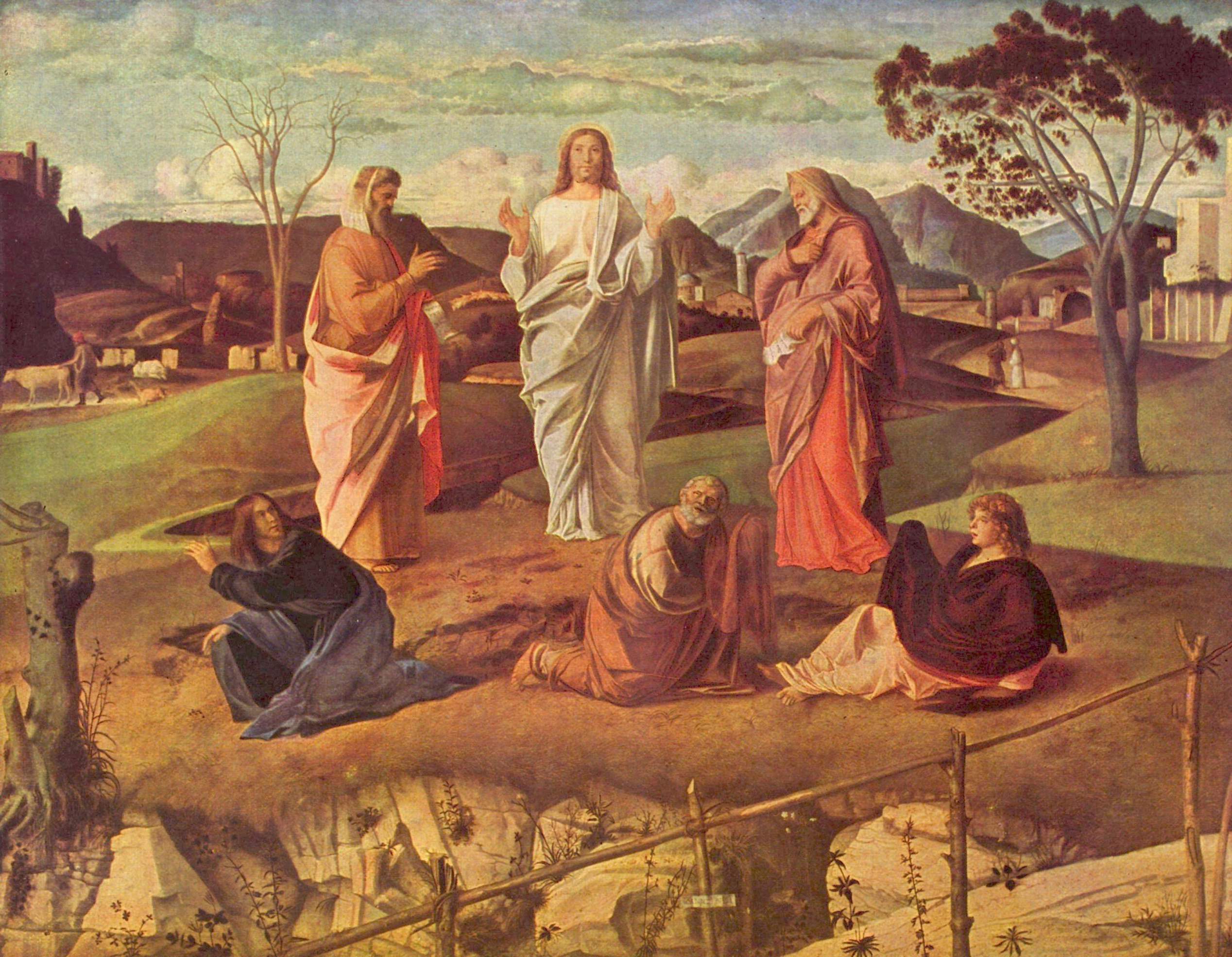
Image: Giovanni Bellini, The Transfiguration of Christ, c. 1480, Museo di Capodimonte, Naples. Reproduction from The Yorck Project via Wikimedia Commons, identified there as public domain. This Renaissance painting illustrates a later reception of the Gospel narrative; it is not ancient material evidence for teachings about a metaphysical veil. [15]
The Veil in Hebrews: Someone Has Entered Before Us
Hebrews 6:19–20 describes hope through the image of an anchor reaching into the interior beyond the veil. Jesus has entered there on behalf of others as a forerunner and is identified as a high priest in the order of Melchizedek. The passage concerns confidence in an access established through him. [1]
The sanctuary setting is essential. The veil belongs to a vocabulary of sacred space, restricted entry and priesthood. The text does not introduce it as a screen displaying an artificial universe. Reading it immediately as an ancient description of simulated reality would replace its stated religious setting with a modern explanation.
The designation of Jesus as a forerunner also matters. His entry is represented as consequential for others. The emphasis falls on an opened relationship, rather than on the discovery that a solitary individual can escape into an otherwise inaccessible region.
The boundary therefore acquires a different significance. What marks restricted access becomes the location of a promise. The question is how people relate to a way established on their behalf, rather than how they independently acquire enough power to overcome a divine barrier.
Through the Veil, Through the Flesh
Hebrews 10:19–22 connects entrance into the sanctuary with Jesus’s blood and describes a newly opened way through the veil, identified with his flesh. Readers are called to approach with sincerity, faith and purification. The following verses connect this approach with perseverance, communal gathering, love and good works. [2]
This is a difficult passage to reconcile with an interpretation that simply opposes spiritual liberation to embodiment. Christ’s embodied existence and sacrificial death belong to the explanation of access. Removing the flesh from the argument would change its logic.
The passage also distinguishes an enabling event from a continuing response. The readers do not create the way by understanding it, yet their trust, conduct and relationships remain consequential. An opened way does not make preparation irrelevant.
For comparison with awakening, this suggests that recognising a possibility and bringing that possibility into existence are different things. A person’s changed understanding may initiate a response to an access the text already declares available.
The Torn Temple Curtain
Mark 15:37–38 places the tearing of the temple curtain immediately after Jesus’s death. It is torn from top to bottom. The event belongs to the Gospel’s narrative presentation of that death and its significance. [3]
The image invites interpretation, but these verses do not themselves supply a complete theory of spiritual consciousness. They do not set out successive states of enlightenment or define a condition called Christ consciousness.
Readers should also distinguish the sanctuary imagery in Hebrews from Mark’s account. Comparing them can illuminate early Christian uses of sacred boundaries, but it does not establish that the authors intended every detail to function identically.
Our comparative observation is that unveiling can be represented as an event understood to change relationships between God, humanity and sacred space. It need not refer exclusively to a psychological obstacle within an individual. An account that makes every veil a synonym for personal ignorance would lose that distinction.
Paul: Unveiling and Becoming Different
In 2 Corinthians 3:12–18, the veil operates within another argument. Paul interprets Moses’s veiled face and extends the language of veiling to the reading of scripture and to the heart. Turning to the Lord is associated with removal of the veil. The passage then connects an unveiled beholding or reflecting of the Lord’s glory with continuing transformation into the same image through the Spirit. [4]
This is Paul’s situated Christian theological interpretation of Moses, covenant and revelation. It should not be presented as a neutral historical description of Judaism or as evidence that Jewish readers lacked spiritual understanding.
For the present inquiry, the important relationship is between perception and formation. The person does not merely obtain information previously concealed. The relationship with the glory beheld is represented as transformative.
The change nevertheless remains attributed to the Spirit. Paul does not explain it as the recipient discovering that they are independently the ultimate source of divinity. Transformation is profound without ceasing to be relational.
Seeing Glory Is Not Necessarily Becoming Transformed
The Transfiguration provides a useful test of that distinction. In Mark 9:2–8, Jesus takes Peter, James and John up a mountain. He is transfigured before them; his clothing becomes dazzling, Moses and Elijah appear, and a voice from the cloud identifies him as the beloved Son and directs the disciples to listen to him. [14]
The narrative describes a revelation witnessed by particular disciples. It does not say that witnessing the event immediately gives them complete understanding or an identical transformed condition. On the descent, they are instructed to remain silent until the Son of Man has risen, and they question what rising from the dead means. Their extraordinary experience coexists with continuing uncertainty. [14]
This makes the scene especially relevant to modern discussions of awakening. An encounter interpreted as divine can exceed the recipient’s ability to understand it. Experience, interpretation and enduring transformation need not occur together.
The conclusion drawn here is comparative: seeing something extraordinary does not, by itself, establish what the observer has become. A historical inquiry must also ask how a source describes subsequent understanding, practice and conduct.
Bellini’s painting accompanies this article because it visualises the disclosure of Christ’s glory. Its relevance does not depend on treating the Gospel event as a literal journey outside the universe or as an ancient illustration of a modern theory of consciousness.
Christ Within: A Transformed Identity
Galatians 2:19–20 describes Paul’s life through participation in Christ’s crucifixion and Christ’s life within him. The statement remains connected with the life Paul continues to live in the flesh and with faith. His embodied existence has not simply become irrelevant. [5]
John 17:20–23 offers another relational account. Jesus prays for the unity of believers, connecting their unity with that of Father and Son and with a witness directed towards the world. These passages have different literary settings and should not be treated as interchangeable descriptions of one experience. [5]
Neither passage can automatically be translated into the assertion that every person is already identical with God in every respect. Faith, indwelling, unity and mission belong to their respective arguments.
For our comparison, transformed identity need not entail the elimination of every distinction. A person can be represented as living through a relationship that changes the direction of action while remaining someone who acts, trusts and responds to others.
This qualifies the metaphor of leaving a cinema after becoming absorbed in a film. Christian participation may concern a changed way of living an embodied life, rather than a departure that makes all action within that life meaningless.
The Gospel of Philip: Which Ancient Witness?
The Gospel of Philip brings the discussion particularly close to the original theme of Gods Behind the Veil. Before examining its imagery, however, its historical position needs to be clear.
NASSCAL describes the work as probably composed in Greek in the late second or early third century. The surviving text is Coptic and belongs to Nag Hammadi Codex II, a fourth-century manuscript. The proposed date of composition and the date of the surviving physical witness are different kinds of information. [7]
The work is commonly associated with Valentinian Christianity. Its title does not establish authorship by the apostle Philip, and it is not a continuous narrative of Jesus’s ministry comparable to the canonical Gospels. It is valuable evidence for a particular configuration of early Christian teaching, rather than a transparent record of everything the historical Jesus taught. [7]
Entering Within the Veil
In its concluding discussion, the Gospel of Philip connects the veil, the holy of holies and the bridal chamber. Isenberg’s translation describes an inferior divine order unable to mix with unmixed light and flawless fullness, while qualified participants enter with the high priest. [6]
This is an unusually relevant ancient comparison for the idea that some people may gain access to a condition unavailable to lower divine powers. Its significance depends on retaining its qualifications. The passage does not simply declare that every human automatically possesses unrestricted access beyond every god.
The same composition elsewhere insists on receiving resurrection during life rather than postponing it entirely until after death. Its conclusion likewise connects receiving light in the present with the recipient’s subsequent condition. [6]
Together, these passages suggest that possible access and realised participation are distinguishable. Naming a destination is not equivalent to already possessing the condition associated with entry.
This is an interpretation of the selected passages, not proof of a universal ancient teaching. The work supplies a specific contrast between qualified participants and inferior powers. Extending that contrast to all humanity and every divine being would require evidence the passages do not provide.
The Bridal Chamber and the Limits of Reconstruction
The meaning and enactment of the bridal chamber remain subjects of scholarly discussion. NASSCAL’s guide places the theme within the work’s Valentinian associations and records debate concerning its ritual character. [7]
Calling the bridal chamber an altered state, a sacrament, a marriage or a symbol does not independently resolve those questions. Its vocabulary must be considered alongside baptism, anointing, redemption and the other religious relationships invoked by the text.
For that reason, modern language about consciousness is best used to formulate questions. It should not replace the ancient vocabulary before its implications have been examined.
The relevant question is how people are represented as becoming capable of participation. The text’s distinction between admitted participants and inferior powers makes qualification central; biological humanity alone should not be assumed to explain entry.
Becoming Divine Is Not Exclusively Gnostic
Language about humanity’s participation in divine life is not confined to writings preserved at Nag Hammadi. Athanasius, in On the Incarnation 54.3, connects the Word’s becoming human with humanity’s deification, knowledge of the unseen Father and immortality. His argument is grounded in the incarnation. [8]
This provides a counterexample to the assumption that becoming divine must mean escaping an inferior creator. Athanasius explains humanity’s transformation through the divine Word’s activity.
Similar expressions can therefore belong to different accounts of causation. Participation in divine life and liberation from ignorant lower powers may both be described loosely as ascent, yet they need not make the same claims about creation or salvation.
The historical task is to ask who enables the change, what changes and which distinctions remain. The expression becoming divine cannot answer those questions by itself.
Participation and Divine Origin
The contemporary Catholic Catechism, paragraph 460, preserves language of participation in divine nature and cites earlier Christian formulations concerning deification. It situates that participation within its explanation of why the Word became flesh. This is a modern doctrinal witness to the continuing use of such language, not an ancient manuscript or a statement representing every Christian tradition. [9]
The example helps distinguish sharing in divine life from being its ultimate origin. A participant can be profoundly changed without being represented as the independent cause of divine reality.
This distinction also qualifies the language of returning to an original level of existence. Recovery of an origin, restoration, adoption and communion are different explanatory models. They may be compared, but their differences should remain visible.
Christ Consciousness: A Modern Interpretation
The English expression Christ consciousness is not the technical vocabulary of Hebrews, Paul or the Gospel of Philip. One documented modern use appears in Paramahansa Yogananda’s teachings, where it concerns universal divine intelligence or consciousness manifested in Jesus and understood as accessible through spiritual realisation. [10]
This belongs to a cross-cultural religious interpretation relating Christian language to Yogananda’s understanding of yoga. A claim to express the inner meaning of Jesus’s teaching is different from a historical demonstration that Jesus taught that modern formulation.
A letter dated 1935 and reproduced by Self-Realization Fellowship connects Christ consciousness and Christ peace with universal perception, love among peoples and international understanding. It documents a pre-internet use of the expression, without establishing its earliest occurrence. [11]
The historical question is how a modern teacher organised inherited religious language within a particular account of spiritual realisation. Investigating that process neither proves nor disproves the associated spiritual claims.
Is Passage Through the Veil Enlightenment?
Enlightenment can serve as a comparative question, provided its meaning is stated. If it means increased information, it is too narrow for sources connecting knowledge with purification, participation and changed conduct.
If it means an extraordinary experience, the Transfiguration narrative reminds us that experience and understanding need not coincide. A moment of disclosure does not automatically establish a completed transformation.
If it means a changed way of being, the comparison becomes more useful. Even then, transformation through Christ’s priestly action, transformation through the Spirit and realisation within a modern yogic interpretation remain historically different explanations.
The proposal here is conditional: enlightenment can be compared with passage through a veil when it names a change in knowing, participating and acting. The comparison becomes misleading when it erases the particular agents, practices and relationships through which a source explains the change.
Material Evidence: The Baptistery at Dura-Europos
Archaeology provides evidence of another kind. Yale’s account of the Christian building at Dura-Europos describes a house adapted for communal use around 240 CE, including a decorated baptistery. [12]
A surviving painting of Christ healing a paralysed man belonged to that setting. The Institute for the Study of the Ancient World identifies the man represented in successive conditions: bedridden and then carrying his bed. Its curatorial interpretation connects the scene with water and redemption. [13]
The setting matters because transformation was represented within a space equipped for religious practice. Images of changed capability stood within a material arrangement for baptism.
This does not establish that participants used the expression Christ consciousness or followed the precise distinctions proposed in this article. Nor does an excavated baptistery verify a metaphysical passage.
The evidence supports a more limited conclusion: communities organised spaces, images and practices around changes in religious condition. Material remains can illuminate how transformation was enacted and represented, even when they cannot confirm the divine outcome participants expected.
Three Boundaries, Different Functions
The comparison now permits three distinctions. The sanctuary veil concerns access expressed through sacred space and priesthood. Hebrews makes Christ’s entry and the way opened through him central.
The veil over understanding concerns recognition and transformation. Paul associates its removal with turning to the Lord and with the Spirit’s activity.
The boundary of differentiated participation concerns who can enter a particular divine condition. The Gospel of Philip develops this through the high priest, the holy of holies, the bridal chamber and the limits of inferior powers.
These are analytical descriptions, not a system jointly articulated by the ancient authors. Their shared feature is a changed relationship to what was concealed or inaccessible. Their differences concern the obstacle, the enabling agent and the condition of participation.
The stronger comparative question is therefore what each veil does within its source. Establishing that function should precede any claim that all veils represent one hidden structure of reality.
What Changes on This Side of the Veil?
Several selected sources connect spiritual access with continuing embodied relationships. Hebrews links approach with perseverance, communal encouragement and good works. Paul describes life in Christ within an ongoing human existence. Yogananda’s modern letter connects its vocabulary with relations among peoples.
These remain different religious arguments. Their comparison nevertheless suggests that a claimed spiritual change may be expected to affect how a person lives.
This is not a universal test capable of proving enlightenment. It is a concrete historical question: what did an author or community expect transformed participation to make possible?
The question also keeps the cinema metaphor open to revision. Awakening might be interpreted as leaving the theatre, but the sources examined here often direct attention towards a changed relationship with life already being lived.
Access, Recognition and Participation
The synthesis proposed here distinguishes access, recognition and participation. Access concerns the opening of a way. Recognition concerns understanding its significance. Participation concerns the person’s effective relationship with the life or reality approached.
The three may be connected without being simultaneous. A way can be represented as open before someone recognises it. A revelation can exceed the observer’s understanding. Recognition can begin a response whose fulfilment remains future.
This yields three conclusions. First, the selected Christian accounts of transformation cannot be reduced to discovering that the ordinary world is unreal. Their explanations involve divine action, embodiment, mediation, worship and conduct.
Second, union does not necessarily mean indistinguishability. Accounts of participation can retain a relationship between the divine source and the person transformed.
Third, the Gospel of Philip offers a particularly close comparison with the original theme of Gods Behind the Veil: qualified participants enter a condition that an inferior divine order cannot assimilate. That specific claim deserves attention without being expanded into a universal doctrine.
The resulting interpretation is that passage can mean a changed capacity for relationship, rather than movement alone. What becomes accessible, how it is recognised and how participation changes a life are separate questions. Keeping them distinct allows comparison to produce an argument while preserving the historical differences on which that argument depends.
Selected Sources and Further Reading
- [1] Letter to the Hebrews 6:19–20. New American Bible, Revised Edition, text and notes, United States Conference of Catholic Bishops. Primary literary source for hope reaching within the veil and Jesus as forerunner and high priest.
- [2] Letter to the Hebrews 10:19–25. Text and notes, New American Bible, Revised Edition, USCCB. Used for entrance into the sanctuary, the way through the veil identified with Christ’s flesh, and the associated communal and ethical exhortations.
- [3] Gospel according to Mark 15:37–38. Text and notes, New American Bible, Revised Edition, USCCB. Primary narrative source for the tearing of the temple curtain.
- [4] Paul, Second Letter to the Corinthians 3:12–18. Text and notes, New American Bible, Revised Edition, USCCB. Used for Paul’s interpretation of Moses, unveiling and transformation through the Spirit.
- [5] Paul, Letter to the Galatians 2:19–20, text and notes; Gospel according to John 17:20–23, text and notes. New American Bible, Revised Edition, USCCB. Used for life in Christ and relational unity; the article does not assume that the passages describe one identical experience.
- [6] Isenberg, Wesley W., trans. “The Gospel of Philip (II,3).” In James M. Robinson, ed., The Nag Hammadi Library in English, 3rd ed., 141–160. San Francisco: HarperSanFrancisco, 1990. Online presentation, Gnostic Society Library. Relevant passages include Nag Hammadi Codex II,3, 73.1–8 on resurrection during life and the concluding discussion at 84–86 on the veil, light and participation. The online presentation is an edited rendering. This article paraphrases the passages and does not generalise their qualified claims to all humans and all gods.
- [7] Laflèche, Emily. “The Gospel of Philip.” e-Clavis: Christian Apocrypha, North American Society for the Study of Christian Apocryphal Literature. Created February 2017; current as of June 2026. Scholarly guide used for proposed composition date, the fourth-century Coptic manuscript, Valentinian associations, ritual debates and bibliographic information.
- [8] Athanasius of Alexandria. On the Incarnation 54.3. Historical English translation, New Advent, reproduced from the Nicene and Post-Nicene Fathers series. Primary theological source connecting incarnation with deification, knowledge of the Father and immortality.
- [9] Catechism of the Catholic Church, paragraph 460. “The Son of God Became Man.” Official Vatican presentation. Modern doctrinal witness to participation in divine nature, distinguished here from ancient literary and manuscript evidence.
- [10] Yogananda, Paramahansa. Published excerpt from The Yoga of Jesus, Self-Realization Fellowship, especially the section on Christ consciousness as oneness with divine intelligence and bliss pervading creation. Primary source for a modern religious interpretation, rather than independent historical verification of Jesus’s teaching.
- [11] Yogananda, Paramahansa. Letter from India on Christ consciousness, dated 1935 by Self-Realization Fellowship, which reproduces it. Evidence for a documented pre-internet use of the expression, not a claim about its earliest occurrence.
- [12] Yale University Art Gallery. “Christian Building.” Dura-Europos: Excavating Antiquity. Museum account of the building’s adaptation around 240 CE and its decorated baptistery.
- [13] Institute for the Study of the Ancient World, New York University. “Wall Painting of Christ Healing the Paralytic.” Edge of Empires exhibition. Yale University Art Gallery, Yale-French Excavations at Dura-Europos, accession 1932.1202. The exhibition dates the painting approximately 232 CE, whereas Yale’s building overview dates the Christian adaptation around 240 CE. This article therefore uses the broader third-century setting without treating the catalogue dates as identical. Used for the painting’s context, successive representations of the healed man and curatorial interpretation.
- [14] Gospel according to Mark 9:2–10. Text and notes, New American Bible, Revised Edition, USCCB. Primary narrative source for the Transfiguration and the disciples’ subsequent questioning. The distinction between witnessing revelation and completed transformation is the article’s comparative interpretation.
- [15] Bellini, Giovanni. The Transfiguration of Christ, c. 1480. Museo di Capodimonte, Naples. Image record and rights information, Wikimedia Commons. Reproduction from The Yorck Project, identified as public domain. The file record dates the painting 1480–1485. Used as a later artistic interpretation of the Gospel narrative, not ancient archaeological evidence.