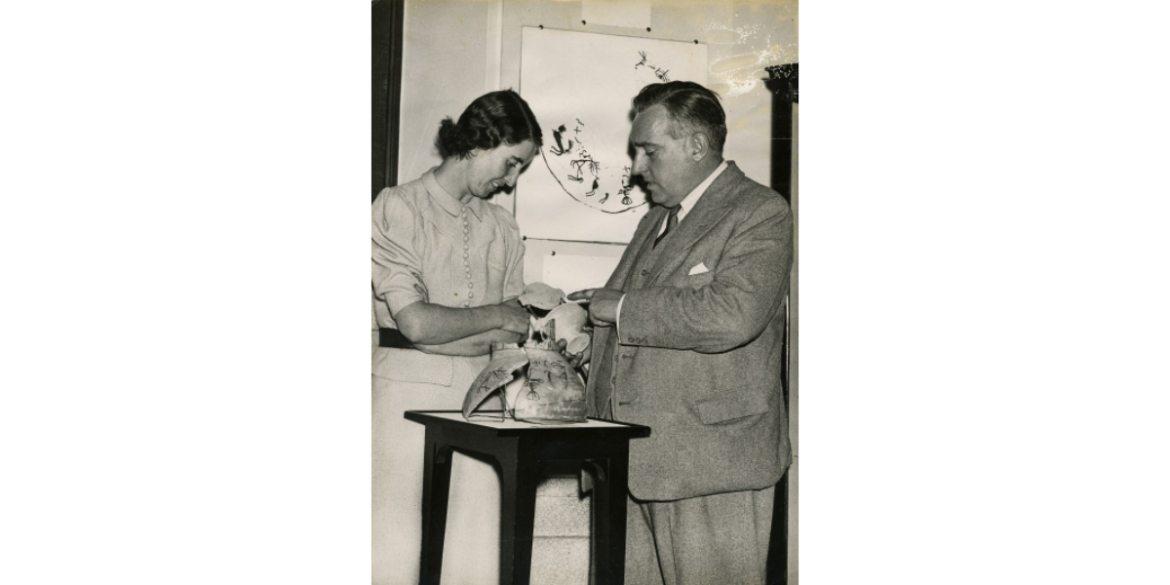
The Disputed Ground of Lachish: Reassessing the Murder of James Starkey
On 4 May 1937, a Palestinian landowner petitioned the Department of Antiquities in Jerusalem about ground being used for archaeological excavation. Salih al-Hajj Hamad Abu Awwad complained that promised compensation had not reached him. Eight months later, James Leslie Starkey, director of the excavations at Tell ed-Duweir, ancient Lachish, was murdered while travelling to Jerusalem. The petition does not establish who killed him. It does establish that a grievance later invoked to explain his death existed before the shooting. That distinction is central to a new investigation by Roy Marom and Yosef Garfinkel.
Published in September 2026 in the Bulletin of the History of Archaeology, their study argues for a locally arranged assassination involving Palestinian rebel commander Issa al-Battat. It combines Palestinian historical accounts and oral testimony with British administrative documents and intelligence material. The argument strengthens a contested explanation of the murder; it should not be mistaken for a newly recovered confession or an uncontested identification.
A cultivated mound beneath an ancient city
Starkey began excavating Lachish in 1932. The expedition’s financial foundations were international and private: Henry Wellcome supported the work alongside Charles Marston and Robert Mond. As the Wellcome Collection’s archival catalogue records, the project’s name and funding arrangements changed as patrons withdrew or died. Behind the familiar image of a director commanding an excavation stood a continuing negotiation over money, personnel and institutional support.
Its best-known discoveries included the Lachish Letters, Hebrew texts written in ink on pottery fragments, or ostraca. The British Museum’s account of Letter II places the group near the city’s main gate in a burnt deposit associated with the Babylonian destruction in the early sixth century BC. Correspondence between military personnel brought ancient administration into unusually close focus: named individuals communicated through a medium that survived because ordinary pottery endured.
The letters also illustrate the collaborative character of interpretation. Excavation supplied their context; reading depended on specialists in ancient Hebrew, while the ink itself became a subject of scientific investigation. In a 1937 contribution to Nature, Alkin Lewis reported chemically examining the documents at Starkey’s request during the summer of 1935. Archaeological knowledge was being assembled through field records, inscriptions and laboratory work well before the expedition’s violent interruption.
Yet the surface above those ancient deposits was agricultural land. In his 2016 study of the murder, Garfinkel distinguished the land surrounding the mound, its slopes and its summit. These offered different possibilities for cultivation and excavation. The summit was particularly desirable to the archaeologists, and access to it became particularly contentious. Negotiations failed to produce an enduring agreement; compulsory acquisition by the Mandatory government enabled work to proceed.
This is an archaeological problem as well as a question of ownership. A trench must occupy a particular place if it is to answer a particular question. Its position can also remove a crop, interrupt grazing or change access to neighbouring plots. The scientific value of buried remains does not resolve those competing demands. At Lachish, the ancient city and the cultivated hill were the same ground, understood through different needs.
From a land grievance to a murder hypothesis
Garfinkel’s earlier reconstruction drew on expedition reports and administrative archives. His argument was that incomplete compensation supplied a motive for revenge. Reports written for sponsors are useful here because excavation directors had to explain practical obstacles alongside discoveries. They can preserve negotiations that disappear from the finished account of a temple or city gate. They also present those negotiations through the director’s priorities and language.
The new research changes the evidential balance by introducing a complaint from the other side of the transaction. A petition is a purposeful document: its author seeks intervention and presents a case accordingly. It therefore needs comparison with agreements, receipts and official correspondence. Nevertheless, it prevents the dispute from being reconstructed exclusively through the people seeking permission to excavate.
The Hebrew University’s account of the research reports that compensation was not finalized until 1943. It also describes a divided local response to the expedition. Employment and medical care benefited some residents; loss of agricultural access and exclusion from jobs embittered others. Such differences matter. A village cannot be assigned a single interest, still less collective responsibility for a killing, because particular landowners had reasons to resent an excavation.
Economic benefit and resentment could coexist within a household, as well as between families. Wages might compensate for lost cultivation without making the loss acceptable. Conversely, a serious grievance need not produce support for violence. These possibilities make local social relationships essential to any explanation, but they also expose the limits of reasoning backwards from an outcome. Knowing that Starkey was murdered cannot turn every earlier disagreement into a preparatory step.
The wider setting was the Arab Revolt of 1936–1939 against British rule in Mandatory Palestine. Local disputes could acquire new possibilities in an environment of armed insurgency. That does not make the dispute and the revolt interchangeable explanations. One concerns why particular people might have wanted Starkey dead; the other concerns the political circumstances in which armed men could intercept and kill him.
A suspect already present in the record
On 10 January 1938, Starkey was travelling to attend the inauguration of the Palestine Archaeological Museum in Jerusalem, now known as the Rockefeller Museum. According to the university’s account, armed men stopped his vehicle near Hebron, identified his connection to the Lachish excavation and released the driver before killing him. The researchers suggest that attacking away from Lachish could have reduced the danger of British reprisals against al-Qubayba. That proposed calculation remains an interpretation of the location.
Al-Battat’s name is not wholly new to the scholarship. Marom and Garfinkel’s discussion makes clear that earlier researchers had considered his involvement, although they differed over its strength and implications. The recent contribution is therefore better described as a reinforced attribution within a fuller local explanation than as the first discovery of an unknown suspect.
The distinction between commanding an operation, arranging it and firing the fatal shots also deserves care. Historical sources may attach responsibility to a commander without documenting every action at the scene. Establishing that an armed group participated would not automatically establish who commissioned it. Naming a likely perpetrator answers only part of the historical question.
There is a real scholarly disagreement behind the renewed attention. David Ussishkin’s 2019 response to Garfinkel presented additional evidence supporting an attack by bandits from the Hebron area. Josef Mario Briffa’s 2021 investigation, based on a Colonial Office file at Britain’s National Archives, supported an explanation rooted in the Mandate’s political upheavals. These were archival counterarguments, not simply repetitions of an inherited story.
The competing explanations require comparison at the level of individual claims. Evidence identifying attackers has a different function from evidence explaining their motive. A grievance establishes neither a commission nor a chain of command. Equally, an attack conducted by insurgents does not exclude a local commission. The strongest reconstruction would connect these propositions through evidence that is independent of the proposed narrative.
Reading the excavation against its archives
Oral history is particularly valuable where published excavation accounts give local people little room to explain their own experience. Its value does not depend on treating inherited memories as eyewitness statements. Memories can preserve the substance of a conflict while compressing chronology, merging participants or leaving responsibility unresolved. Administrative archives have corresponding weaknesses: official status does not guarantee that an investigator understood local relationships or obtained reliable information.
For this case, the crucial methodological question is how independently the accounts arose. Several documents repeating an allegation may preserve one circulating story rather than several confirmations. A later narrative may incorporate published material. Conversely, an independently collected account that agrees with an earlier petition can strengthen the history of the grievance even when it cannot identify a murderer. Agreement needs to be assessed claim by claim.
A useful comparison comes from another part of Starkey’s career. In a 2024 study of archaeological labour at Qau in Egypt, Maarten Horn compared Starkey’s postcards and photographs with official excavation reports. The informal material revealed Egyptian contributions to establishing the camp and identifying places to excavate that the formal publications obscured or contested. The comparison demonstrates how the genre of a surviving record can shape who appears to have produced archaeological knowledge.
At Lachish, that insight encourages a wider definition of the excavation archive. Land correspondence belongs beside plans and pottery registers because access determined where excavation was possible. Workers’ experience belongs beside directors’ reports because archaeological observations depended on collective labour. John D. M. Green and Ros Henry’s edition of Olga Tufnell’s letters and photographs similarly places daily fieldwork within the social and professional relationships of the Mandate period.
The murder did not immediately extinguish the expedition’s work. As the Palestine Exploration Fund’s biography of Tufnell records, she and her colleagues finished the season. She then devoted two decades to bringing the results to publication. The Wellcome publication archive documents the resulting sequence: the letters volume in 1938, the Fosse Temple in 1940, the Iron Age in 1953 and the Bronze Age in 1958. The excavation’s scientific afterlife depended on that sustained work.
The present evidence supports a serious case for al-Battat’s involvement and makes local land grievances impossible to dismiss from the investigation. It does not give equal certainty to the identity of the gunman, the arrangements behind the attack and the motives of everyone involved. The unresolved task is to establish those connections more securely. Meanwhile, the history of Lachish must accommodate both the ancient documents recovered from its soil and the modern documents recording what excavation cost the people who cultivated it.
Selected Sources and Further Reading
- Marom, Roy, and Yosef Garfinkel. 2026. The Murder of J. L. Starkey According to Local Palestinian Sources: Anti-Colonial Struggle and Local Intrigues. Bulletin of the History of Archaeology 36(1), 1–14.
- Garfinkel, Yosef. 2016. The Murder of James Leslie Starkey near Lachish. Palestine Exploration Quarterly 148(2), 84–109.
- Ussishkin, David. 2019. The Murder of James Leslie Starkey: Addendum to the Paper of Yosef Garfinkel. Palestine Exploration Quarterly 151(2), 146–154.
- Briffa, Josef Mario. 2021. The Murder of James Leslie Starkey near Lachish: A Different View from a Colonial Office File. Palestine Exploration Quarterly 153(3), 173–190.
- Green, John D. M., and Ros Henry, editors. 2021. Olga Tufnell’s ‘Perfect Journey’: Letters and Photographs of an Archaeologist in the Levant and Mediterranean. UCL Press.
- Horn, Maarten. 2024. Writing Archaeological Labour at Qau, Egypt, in the 1920s. Bulletin of the History of Archaeology 34(1).
- Lewis, Alkin. 1937. The Lachish Letters and the Use of Iron Inks in Antiquity. Nature 139, 470.
- British Museum. Lachish Letter II. Collection interpretation hosted by Google Arts & Culture.
- Wellcome Collection. Lachish, archive reference WA/HSW/AR/Lac; and Lachish Letters, WA/HSW/AR/Lac/F.
- Palestine Exploration Fund. Olga Tufnell. Institutional biography.
- Hebrew University of Jerusalem. 3 November 2026. Who Killed British Archaeologist James Starkey? Archival Records Shed Light on an 88-Year-Old Mystery. Research announcement republished by Phys.org.