Sulawesi Teeth Reveal an Ice Age Betel-Nut Habit
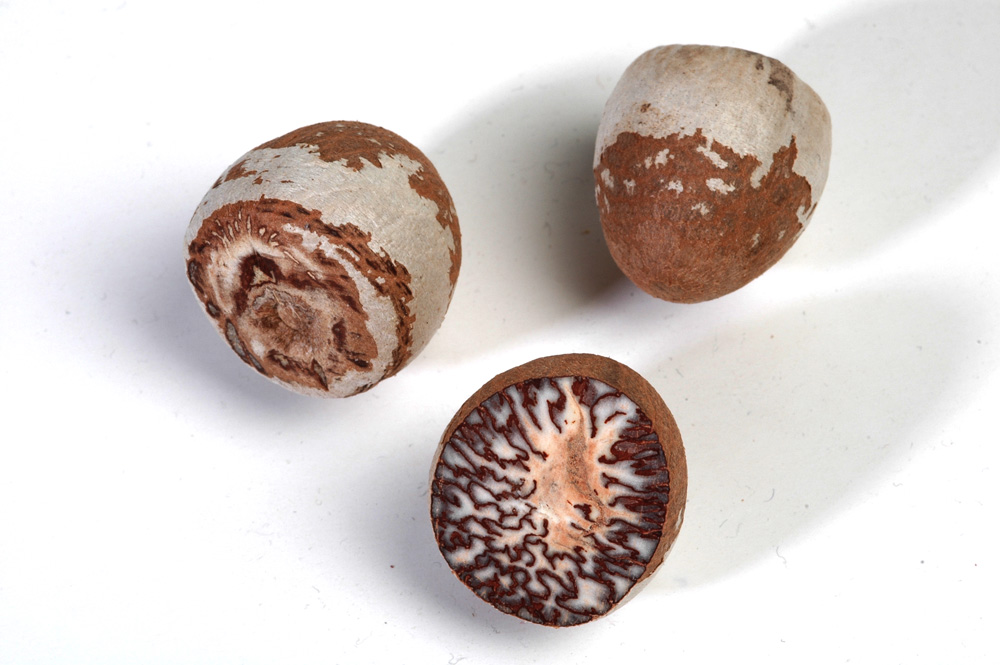
Three molars remain in the fragmentary upper jaw designated Maros-LBB-1a, recovered from Leang Bulu Bettue in southwestern Sulawesi. Their rounded wear records repeated contact with a hard object. The third molar is more heavily worn than the second: an unusual distribution that points to something held at the back of the mouth. In a study published on 9 September 2026, Adam Brumm and colleagues identify that object as an areca seed, commonly called betel nut.
A Habit Preserved in Two Mouths
The jaw comes from layer 4a. Uranium-series dating of stalagmites within the deposit constrains its age to approximately 25,000–16,000 years ago. This is a stratigraphic age bracket, not a direct radiocarbon date on the individual. A second forager, CPL-R2a from Leang Cappalombo 1, dates to approximately 7,600–6,300 calibrated years before present. Liquid chromatography–mass spectrometry detected arecoline in a dental sample from each individual.
The distinction matters when this discovery becomes a headline. Calling the older specimen exactly 25,000 years old selects one end of a substantial interval. Calling it the beginning of drug use makes a different mistake: the earliest surviving evidence cannot identify the first occasion on which someone consumed a psychoactive plant. The defensible claim concerns an exceptionally early, materially documented habit.
Whole Nuts Before the Prepared Quid
Modern betel consumption commonly involves a prepared quid containing processed areca seed, slaked lime and other ingredients. The Griffith-led team, working with Indonesian researchers at Hasanuddin University and BRIN, tested a simpler mechanism. They soaked intact nuts in artificial saliva and applied the resulting solutions to human receptors expressed in frog egg cells. The experiments demonstrated that intact nuts release physiologically active compounds without preparation as a lime-containing quid.
This gives the proposed behaviour a working mechanism. The experiment establishes that sucking a whole nut can deliver a drug; it does not measure the dose taken by either ancient individual or reconstruct their subjective experience. Those are separate questions. Dental wear records repeated physical contact, while chemistry identifies exposure. Their combination is more informative than either observation alone.
The human cost is written into the dentition. The researchers describe damage severe enough to expose pulp chambers, with consequences for pain, infection and eating. Because arecoline has analgesic properties, they propose that people used the nuts to relieve toothache, then suffered worsening damage through continued use. This feedback between relief and injury is an interpretation, not a recovered intention. Neither tooth wear nor residues establish a clinical diagnosis of addiction.
Leang Bulu Bettue Beyond the Teeth
Leang Bulu Bettue belongs to the Maros-Pangkep limestone karst, where excavations begun in 2013 have exposed approximately eight metres of stratified deposits. Burhan and colleagues’ 2025 site report documents a sequence extending from the Middle Pleistocene into the late Holocene. Around 40,000 years ago, the assemblage changes: an earlier cobble-based core-and-flake technology gives way to a different archaeological signature incorporating evidence of artistic expression. The authors discuss population replacement as one explanation, rather than treating technological change as proof of it.
That depth of occupation changes the perspective on the teeth. The nut users belong within a long local history of acquiring materials, processing resources and maintaining practical knowledge. Archaeological interpretation must accommodate that accumulated botanical expertise alongside the stone assemblage. A plant can disappear from the excavated deposit while leaving evidence of its use in a human mouth.
Finding Consumption Without Red Stains
A useful comparison comes from Nong Ratchawat in central Thailand. In 2025, Piyawit Moonkham and colleagues analysed 36 dental-calculus samples from six approximately 4,000-year-old burials. They identified diagnostic arecoline derivatives in one female burial despite the absence of conventional indicators such as conspicuous betel staining or recovered nuts. Their results demonstrate why visual inspection alone produces an incomplete distribution map of ancient consumption. They also caution against assuming every member of a community shared the practice.
The Sulawesi evidence therefore enters a debate about archaeological visibility as much as antiquity. Two individuals cannot establish an uninterrupted tradition across thousands of years, and a positive chemical result cannot separate treatment, pleasure and social custom. What this approach offers is a way to investigate those questions through bodies as well as artefacts. The next task is to establish how widely the behaviour occurred, which preparation methods were used, and how its benefits and injuries shaped everyday life.
References
- Brumm, A., et al. (2026). Betel nut sucking is the earliest recorded evidence for the habitual use of a neuroactive plant drug. Science Advances, 12(37), eaei1901.
- Burhan, B., et al. (2025). A near-continuous archaeological record of Pleistocene human occupation at Leang Bulu Bettue, Sulawesi, Indonesia. PLOS ONE, 20(12), e0337993.
- Moonkham, P., et al. (2025). Earliest direct evidence of bronze age betel nut use: biomolecular analysis of dental calculus from Nong Ratchawat, Thailand. Frontiers in Environmental Archaeology, 4, 1622935.
- Rosengreen, C. (2026). Ice Age origins of one of humanity’s oldest drug habits. Griffith News, 10 September.
Featured image: modern betel nuts from India, photographed by Henryk Kotowski (2008), illustrating the plant material rather than the excavated specimens. Wikimedia Commons, CC BY 2.5.
