Ireland’s Cave-Art Claim Faces the Dating Test
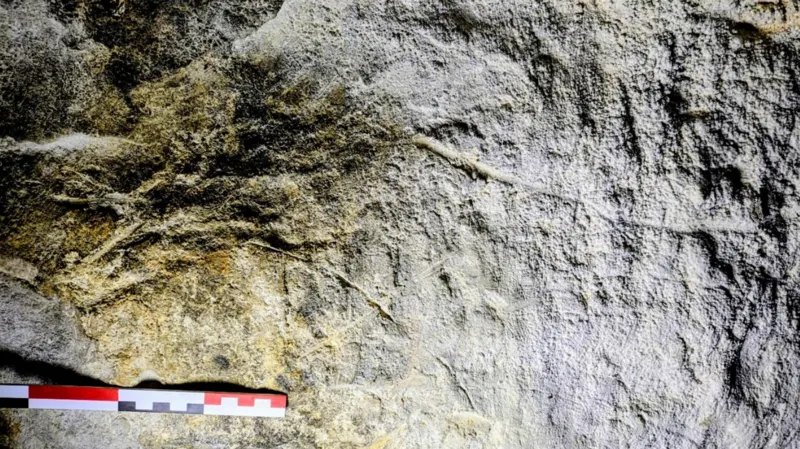
A measuring scale sits beneath an engraving identified as the front quarters of a deer on a limestone wall in southwest Ireland. Published in September 2026, the photograph belongs to a reported group of discoveries in eight caves: incised figures, ochre and charcoal paintings, and grooves drawn through soft deposits with fingertips. The proposed age is at least 15,000 years. That number is the claim requiring verification; the photograph cannot establish it.
Eight Caves, No Published Laboratory Chronology
According to Neil Prior’s BBC report of 4 September, updated on 5 September 2026, the Lost Land Bridge Project used a computer model informed by Welsh cave characteristics to identify 28 candidate caves in southwest Ireland. Investigations produced the eight reported art sites. George Nash coordinated the project with Genevieve von Petzinger and Barbara Oosterwijk. Locations remain confidential because of vandalism and looting risks. The report supplies no laboratory determinations, sample identifiers or calibrated age ranges for the Irish markings. Its 15,000-year attribution therefore remains an estimate, not a measured chronology.
The next investigation must separate three questions: were the marks made by people, when were they made, and what activities accompanied them? A useful verification programme would document incision profiles, stroke intersections, pigment composition and relationships with mineral deposits. Independent examination should test the proposed figures against natural fissures, animal scratches and recent markings. A recognisable animal outline supports an interpretation; it does not supply a calendar date.
The Bear Bone Already Changed the Baseline
The advertised 5,000-year extension rests on an inadequate starting point. In 2016, Marion Dowd and Ruth Carden published a butchered brown-bear patella from Alice and Gwendoline Cave, approximately 3.5 km southwest of Ennis, County Clare. Excavated in 1903 and preserved in the National Museum of Ireland, specimen NMING:F23919 yielded independent radiocarbon determinations from Belfast and Oxford: 12,810–12,590 and 12,810–12,685 cal BP respectively, reported at two-sigma precision. Here, BP means before AD 1950.
Those results already place human activity in Ireland around 12,800–12,600 calibrated years ago. A confirmed age near 15,000 years would extend that benchmark by roughly 2,200–2,400 years. The bone’s antiquity and the identification of ancient butchery marks work together: neither would establish human presence alone. Its survival in an antiquarian assemblage also demonstrates why re-examining museum collections can alter a chronology without a new excavation.
An even earlier claim concerns a reindeer bone from Castlepook Cave, County Cork, reported in 2021 as approximately 33,000 years old and modified by humans. That claim requires its own assessment of dating and modification. Ireland’s earliest occupation is already a debate about particular specimens and their evidential quality, making a simple progression from 10,000 to 15,000 years misleading.
Dating the Mark and the Material Covering It
For a charcoal drawing, accelerator mass spectrometry radiocarbon dating offers a potential direct approach. Sampling must isolate original pigment and remove contamination. The measurement dates the carbon-bearing material: old wood or reused charcoal can predate its application to a wall. Publication therefore needs sample locations, pretreatment procedures, laboratory identifiers, uncertainties and calibration details. Ochre itself is an iron-rich mineral pigment and cannot simply be radiocarbon dated as charcoal can. Any organic component would require separate identification and assessment.
Engravings offer another route where calcite covers the incisions. At Creswell Crags in Britain, Pike and colleagues reported in 2005 that uranium-series measurements on overlying flowstone established an age exceeding 12,800 years for the oldest dated motif. The deposit supplies a minimum age for the carving: the groove existed before the mineral layer formed. It does not date the act of engraving precisely.
This approach depends on demonstrable microstratigraphy. Calcite beneath a mark provides a terminus post quem; calcite sealing it provides a terminus ante quem. Researchers must establish that the sampled crust actually overlies the mark and test for detrital contamination and uranium movement, which can distort apparent ages. A date from nearby calcite cannot be transferred to an image merely because both occupy the same wall.
A Welsh Route Needs Independent Evidence
The proposed crossing from Wales is a separate hypothesis. Edwards and Brooks’s 2008 palaeogeographic modelling placed Ireland’s separation from Britain by about 16,000 years ago. Their reconstruction accounts for changing land elevation under the weight of ice and subsequent rebound, alongside sea-level change. Lower global sea level alone cannot establish a walkable corridor at 15,000 years. Any proposed route must be tested against a dated reconstruction of the intervening landscape.
Securely dated Palaeolithic imagery would expand the evidence from isolated acts of carcass processing to deliberate marking of cave interiors. It would not, by itself, establish permanent settlement, a Welsh origin or continuous occupation through later millennia. The interpretive task is to connect dated marks with stratified deposits and independently dated activity elsewhere. Until that chain exists, the eight caves represent a substantial research opportunity whose chronological consequences remain to be demonstrated.
References
- Prior, N. (2026). Ancient cave art discovery suggests first known humans in Ireland walked over from Wales. BBC News, 4 September, updated 5 September.
- Dowd, M. and Carden, R. F. (2016). First evidence of a Late Upper Palaeolithic human presence in Ireland. Quaternary Science Reviews, 139, 158–163.
- The Journal (2021). Reindeer bone found in Cork cave shows human activity in Ireland 33,000 years ago. The Journal, April.
- Hajdas, I. et al. (2021). Radiocarbon dating. Nature Reviews Methods Primers, 1, article 62.
- Pike, A. W. G., Gilmour, M., Pettitt, P., Jacobi, R., Ripoll, S., Bahn, P. and Muñoz, F. (2005). Verification of the age of the Palaeolithic cave art at Creswell Crags, UK. Journal of Archaeological Science, 32(11), 1649–1655.
- Oktaviana, A. A. et al. (2024). Narrative cave art in Indonesia by 51,200 years ago. Nature, 631, 814–818.
- Edwards, R. J. and Brooks, A. J. (2008). The Island of Ireland: Drowning the Myth of an Irish Land-bridge? Irish Naturalists’ Journal, special supplement, Mind the Gap: Postglacial Colonisation of Ireland, 19–34.