Faces Prepared for Eternity: Egypt’s Fayoum Portraits Go to Rome
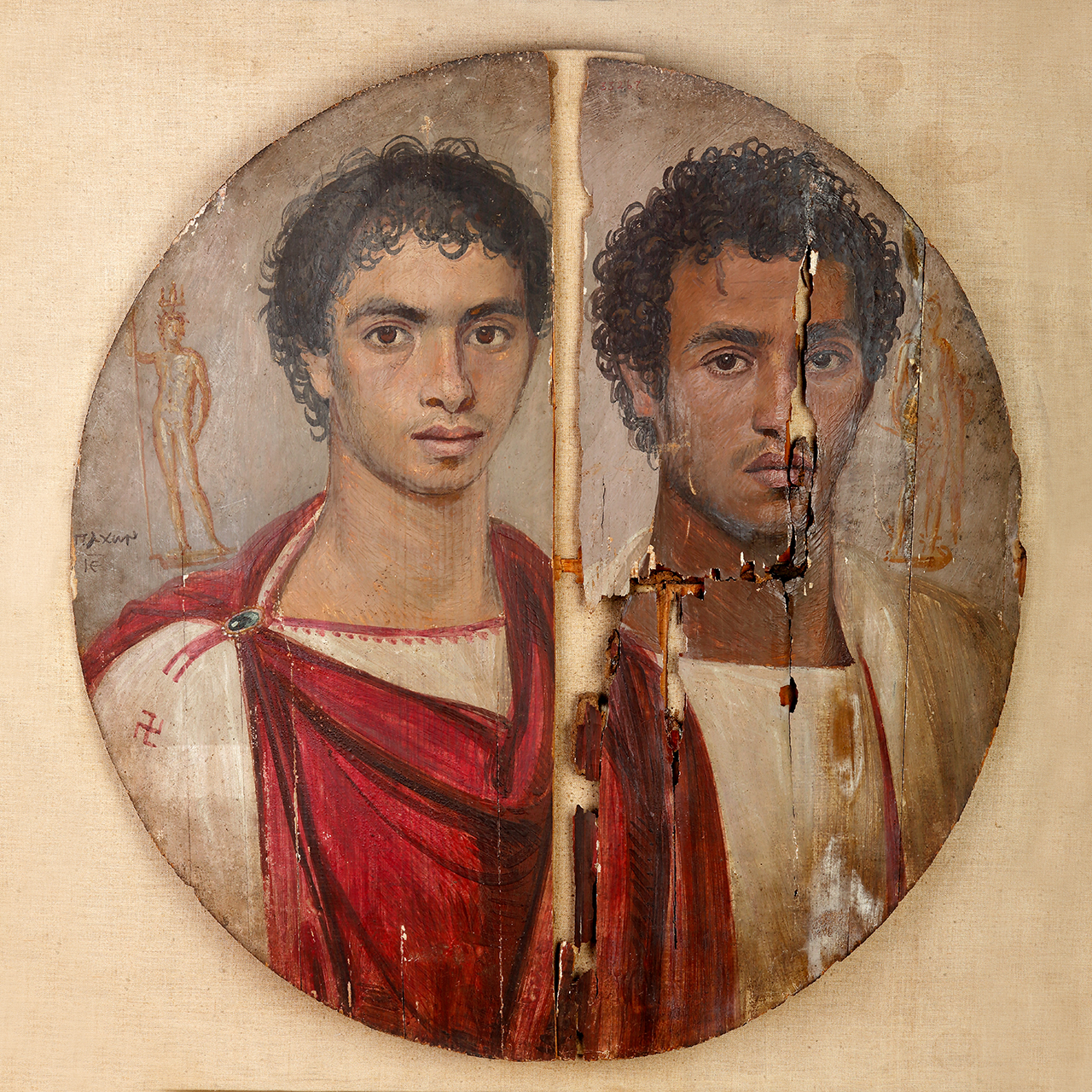
The right-hand figure in the Tondo of the Two Brothers has long been difficult to see. Damage to the circular wooden painting interrupted the face and obscured the relationship between its two subjects. On 11 October 2026, Egypt unveiled the panel after conservation by Egyptian and Italian specialists, ahead of its first journey abroad. According to Associated Press reporting from the announcement, the three-week intervention addressed a fragile painted surface and a wooden support damaged by termites.
The painting will join Egyptian loans at Rome’s Museo dell’Ara Pacis in an exhibition scheduled for November 2026 to May 2027. The novelty needs defining carefully. Fayoum portraits have circulated outside Egypt for centuries. What is new is the overseas presentation of these Egyptian museum holdings, including the restored tondo, rather than the international exhibition of the portrait tradition itself. The exhibition announcement places them alongside loans from the Louvre and other collections.
Even its familiar title asks more of the evidence than it can securely provide. Two men appear together; their biological relationship is unknown. And although the tondo belongs within the study of Roman Egyptian portrait painting, its unusual format makes it an awkward representative of paintings normally inserted into mummy wrappings. The object chosen to introduce this tradition to a wider audience is also one that exposes its interpretative difficulties.
A portrait beyond the Fayoum
The Egyptian Museum identifies the painting’s discovery place as Antinoopolis, at modern el-Sheikh Abada in Middle Egypt, rather than the Fayoum basin. Its catalogue assigns it to the second century CE, associates it with Hadrian’s reign, and describes small divine figures above the men’s shoulders. The younger-looking figure wears a tunic with a purple border; his companion wears white drapery. These are observations about the represented figures, not biographies of the people depicted. The museum’s entry itself qualifies their identification as brothers.
Fayoum, also written Fayum or Faiyum, is a conventional label for a wider Egyptian phenomenon. Portraits have been recovered beyond the region that supplied their collective name. Most examples belong to the first three centuries CE, when Egypt was under Roman rule. Painted panels could be secured over the faces of mummified people, bringing a contemporary-looking likeness into a much older funerary practice. The Metropolitan Museum’s exhibition Ancient Faces, held in 2000, presented the paintings together with masks, coverings and other burial equipment to restore some of that setting.
The distinction matters. A panel hung at eye level in a gallery encourages comparison with later European portraiture. On a wrapped body, its relationship to the deceased and to the surrounding funerary decoration becomes unavoidable. The naturalistic face was part of an arrangement intended to act on behalf of a dead person. Its effectiveness cannot be reduced to how convincingly it reproduces an individual’s appearance.
Nor does the combination of artistic traditions divide neatly into separate peoples. Greek pictorial conventions, Roman fashions and Egyptian mortuary practices describe aspects of the objects. They do not, by themselves, establish a sitter’s ancestry. Clothing can be adopted, painting techniques taught and religious observances shared.
Conservation changes what can be asked
Restoration is often reported as the recovery of an original appearance. That formulation can conceal several different operations: stabilising weakened material, removing an obscuring deposit, or making damaged passages easier to read. Each has different consequences for interpretation. The October announcement establishes that the tondo received treatment, but the reports consulted do not supply a full technical account of its cleaning, consolidation or any visual reintegration. It would therefore be premature to attribute newly visible details to a particular procedure.
A complete conservation publication could distinguish surviving ancient paint from later additions, map losses and explain treatment decisions. Without that documentation, before-and-after photographs cannot answer every question. A clearer face is a welcome result for viewers; for researchers, the crucial evidence includes what was found on the surface and what was done to it.
Comparable research shows why this distinction is necessary. In their examination of two portraits at the Walters Art Museum, Hae Min Park and colleagues documented different approaches to modelling flesh. One painter exploited a dark preparatory layer; the other used pigment mixtures, including Egyptian blue, to build tonal effects. Imaging also revealed tool marks and restoration materials. One panel had been flattened, mounted on a modern board and covered with a resinous coating. The paintings’ present appearances consequently reflect both ancient manufacture and later treatment. Their technical study demonstrates how much close examination can recover beneath an apparently straightforward likeness.
The methods answer different questions. Surface imaging can clarify how paint was manipulated. Elemental analysis locates chemical constituents, while other spectroscopic techniques help identify compounds or binding materials. Agreement between methods strengthens an identification; a single signal may remain ambiguous. None of these examinations should be assumed to have been performed on the Cairo tondo simply because they have proved useful elsewhere.
Wood, wax and the organisation of painting
The Getty-led APPEAR project, begun in 2013, provides a framework for comparing ancient panel paintings across institutions. Its scope includes wooden supports, pigments, binding media and associated funerary materials. The value of the collaboration is partly corrective: an assumption inherited from an older catalogue can be tested against the object and compared with results from other collections. The project’s published findings include colour mixtures whose ingredients would not be apparent from their finished appearance alone.
Wood identification has supplied some of the clearest evidence for connections beyond Egypt. Caroline R. Cartwright’s research, published in 2020, examined microscopic anatomy in small samples from 180 mummy portraits and twenty other painted panels. Imported lime, or linden, dominated that studied assemblage. Identifications depended on examining the wood in three anatomical planes rather than judging its surface appearance. Cartwright’s study links the material’s popularity to its working properties, including its suitability for thin panels.
The result establishes movement of raw material, but leaves room for several production arrangements. Timber might have travelled as boards or as prepared supports. Identifying a tree does not locate the painter’s workshop. Nor should the proportions in an accessible museum sample be treated automatically as the proportions used throughout Roman Egypt. Preservation, collection history and permission to sample all affect the surviving dataset.
A more closely contextualised group comes from Tebtunis in the Fayoum. Johanna Salvant and colleagues combined imaging and chemical analyses to investigate an assemblage whose archaeological associations suggested workshop production. Their 2018 study in Archaeometry identified shared materials and practices, including wax-based paint rich in lead white, iron-containing pigments and additional colourants used for tonal variation. The argument depends on the combination of archaeological association and technical similarities.
That is a stronger basis for discussing production than resemblance alone. Similar eyes or mouths might reflect an artist’s habits, a workshop convention or a widespread pictorial formula. Shared pigments are also insufficient on their own: several painters could buy the same supplies. The most persuasive workshop attribution would bring together preparation, layering, tool use and archaeological context. Even then, distinguishing a single painter from several trained colleagues may remain difficult.
Lifelike does not mean unmediated
The portraits’ apparent immediacy encourages viewers to read personality into a raised eyebrow or direct gaze. Such responses are understandable, but archaeological claims require another standard. An expression belongs to a painted representation shaped by conventions and choices. It cannot establish whether its subject was anxious, kind or ambitious.
Dating introduces a related problem. Hairstyles, jewellery and clothing can be compared with other dated representations. UCL’s Petrie Museum, for example, dates a Hawara portrait of a young man to approximately CE 140–160 using his hair and beard. These comparisons provide chronological evidence, but their precision depends on how quickly fashions spread and how long they remained in use. The museum’s discussion also records a decisive modern alteration: panels were cut from their wrappings, and Petrie framed many like European pictures for exhibition in 1889.
Where portrait and body remain together, their relationship can be tested more directly. A 2020 investigation by S. R. Stock, M. K. Stock and J. D. Almer used computed tomography and targeted X-ray diffraction on Hawara Portrait Mummy 4. The remains belonged to a child aged approximately five, although the painted face appeared older. The work also identified modern steel wires within the wrappings, demonstrating that later interventions form part of the object’s physical history. The study provides a specific comparison rather than a verdict on the accuracy of the entire portrait corpus.
An age discrepancy does not necessarily imply that an unrelated picture was attached to the body. Artistic convention, idealisation or the use of an established facial type could also contribute. Conversely, resemblance does not prove that a portrait was painted from life. The circumstances of commissioning remain a separate question.
The two men and the missing context
For the tondo, interpretation begins with the unusual decision to represent two men together. Anne E. Haeckl’s 2001 article, ‘Brothers or Lovers? A New Reading of the “Tondo of the Two Brothers”’, proposed a relationship different from the traditional sibling identification. The possibility deserves acknowledgement, but composition and religious imagery cannot securely recover a private relationship. The title should remain a convenient designation rather than a settled genealogy.
The original function is similarly unresolved. In her discussion of the painting’s reception, Alethea Roe notes that its large circular format and absence of the usual indications of insertion into wrappings complicate its classification as a mummy portrait in the strict sense. Her analysis makes a useful distinction between belonging to a portrait tradition and having served a particular physical purpose. A commemorative or funerary setting remains possible without requiring attachment over a mummy’s face.
This is where an exhibition can contribute beyond presenting a newly legible image. Showing the tondo alongside wrapped portraits, masks and shrouds permits comparison of objects whose functions should not be assumed identical. Conservation can preserve the panel and improve access to its surviving evidence. It cannot supply an absent burial record or identify the men through the force of their likenesses.
The restored painting therefore reaches Rome with some questions clarified and others intact. It belongs to a world in which portrait painters, woodworkers and funerary specialists drew on resources and conventions extending across the Mediterranean. Whether these particular men were brothers, partners or connected in another way remains uncertain. The most productive next step is a published technical account that places the treatment beside the panel’s construction, inscriptions and surviving history, allowing its new visibility to support a more exact interpretation.
Selected Sources and Further Reading
- Egyptian Museum, Cairo. ‘Tondo of the Two Brothers (Antinoopolis Tondo)’. Collection entry.
- Fahmy, Hamza. 2026. ‘Egypt’s Fayoum mummy portraits to travel abroad for first time after restoration’. Associated Press, 11 October.
- Civita Mostre e Musei. ‘The Power of Portraiture. Egypt and Rome. The Fayum Portraits’. Exhibition announcement, Museo dell’Ara Pacis, 2026–27.
- Svoboda, Marie, and Caroline R. Cartwright, editors. 2020. Mummy Portraits of Roman Egypt: Emerging Research from the APPEAR Project. Los Angeles: J. Paul Getty Museum.
- Cartwright, Caroline R. 2020. ‘Understanding Wood Choices for Ancient Panel Painting and Mummy Portraits in the APPEAR Project through Scanning Electron Microscopy’. In Svoboda and Cartwright, Mummy Portraits of Roman Egypt, chapter 2.
- Salvant, Johanna, et al. 2018. ‘A Roman Egyptian Painting Workshop: Technical Investigation of the Portraits from Tebtunis, Egypt’. Archaeometry 60(4): 815–833.
- Park, Hae Min, Amaris Sturm, Glenn Gates and Lisa Anderson-Zhu. ‘Findings from an Examination of Two Mummy Portraits’. The Journal of the Walters Art Museum 74.
- Stock, S. R., M. K. Stock and J. D. Almer. 2020. ‘Combined computed tomography and position-resolved X-ray diffraction of an intact Roman-era Egyptian portrait mummy’. Journal of the Royal Society Interface 17: 20200686.
- Haeckl, Anne E. 2001. ‘Brothers or Lovers? A New Reading of the “Tondo of the Two Brothers”’. Bulletin of the American Society of Papyrologists 38: 63–78.
- Roe, Alethea. 2016. ‘Not Art But Truth: A Brief History of Mummy Portrait Reception’. Discentes 1(2): 16–32.
- UCL, Petrie Museum of Egyptian and Sudanese Archaeology. ‘Hawara mummy portraits’.
- The Metropolitan Museum of Art. 2000. ‘Ancient Faces: Mummy Portraits from Roman Egypt’. Exhibition overview.