Before the Anunnaki Became Aliens: What Mesopotamian Sources Actually Tell Us
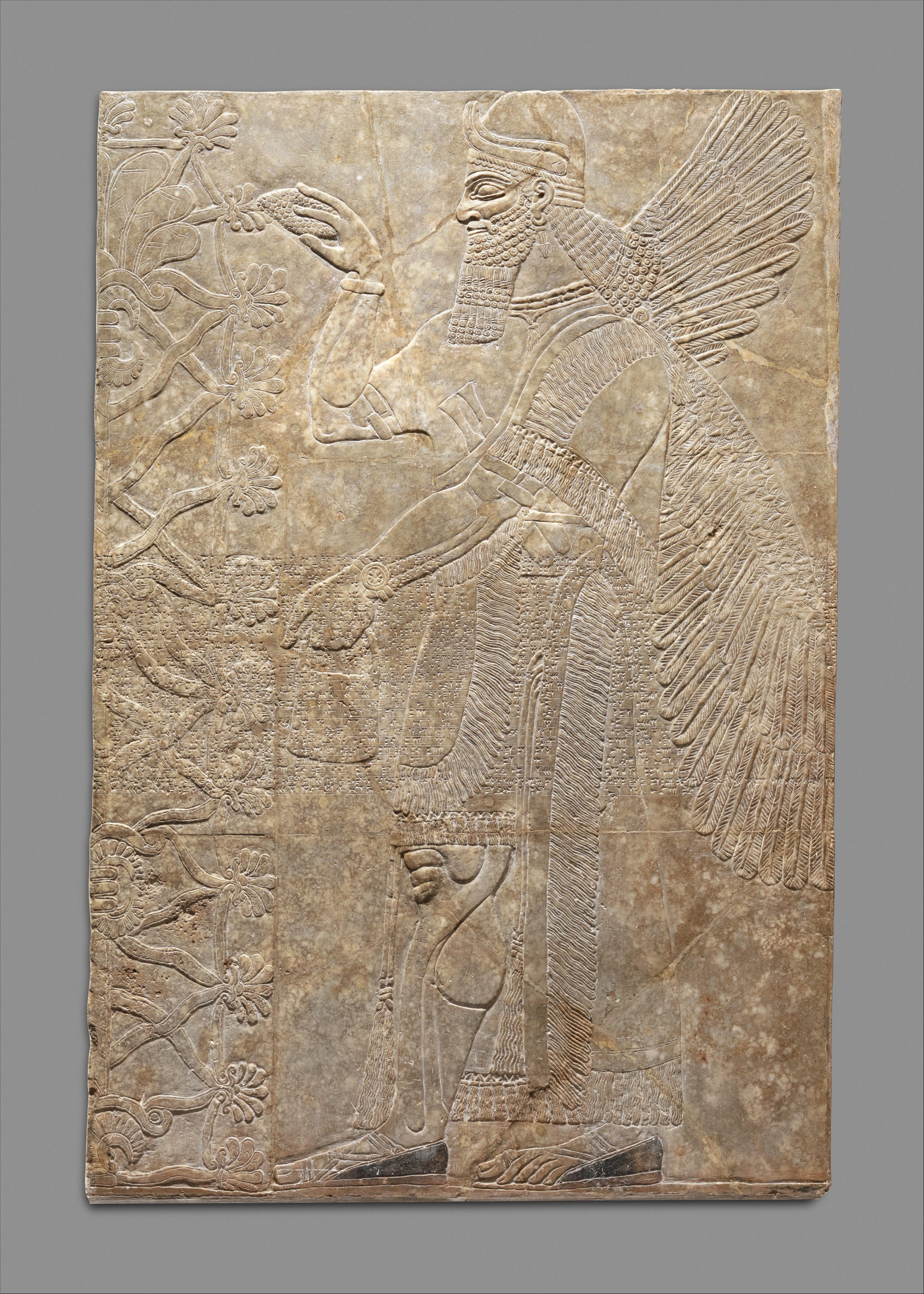
A winged figure carries a bucket and raises a cone beside a stylised tree. Detached from its setting, the image can seem to invite almost any explanation. Is the object a ritual instrument, a technical device, or something its makers could not understand? Before answering, however, there is a more basic question: where did the image stand, and what other evidence belongs with it?
One such relief, now in the Metropolitan Museum of Art, comes from the Northwest Palace at Nimrud, ancient Kalhu, and dates to the reign of Ashurnasirpal II, approximately 883–859 BCE. The museum interprets its imagery in terms of supernatural protection and purification, while acknowledging uncertainty about the cone and the full significance of the scene. Its catalogue distinguishes these supernatural figures from the great gods. Connections with the protective sages known as apkallu are possible, rather than an exhaustive explanation. [1]
Featured image: Neo-Assyrian relief panel from Nimrud, approximately 883–859 BCE. The Metropolitan Museum of Art, object 31.72.1. Gift of John D. Rockefeller Jr., 1931. Image: The Metropolitan Museum of Art, Public Domain. The figure is discussed here as protective supernatural imagery, not as an identified depiction of an Anunnaki deity.
That distinction is the starting point for investigating the Anunnaki. An ancient object is evidence, but the caption attached to it centuries later is a separate claim. Recovering the historical Anunnaki requires bringing words and objects back into their particular settings before combining them into a story.
A divine group with a changing identity
The forms Anunna, Anunnaku and Anunnaki belong to the vocabulary of Mesopotamian religion. They do not consistently designate a fixed membership with a single function. The scholarly reference project Ancient Mesopotamian Gods and Goddesses describes a group whose identity varies across periods and compositions. Sumerian texts can associate the Anunna with major gods or with the divine community of a particular city. In some later contexts, the name has a stronger connection with the underworld, sometimes in contrast to the Igigi. These distinctions were not uniform throughout Mesopotamian history. [2]
This variability matters. A modern account can assemble references separated by language, place and centuries and present them as statements about one unchanging population. The resulting narrative may appear impressively consistent because the differences between the sources have been removed before the comparison begins.
The interpretation proposed here is that those differences should be treated as evidence. A group whose membership and responsibilities change can reveal how communities organised divine authority. Variation need not be damage to an original account that must be repaired. It may be precisely what allows us to follow the history of the concept.
Nor should association with the underworld automatically become evidence of another planet or a concealed dimension. Such an identification requires an argument connecting the ancient usage to the proposed meaning. The existence of an unfamiliar place in a religious narrative does not establish the geographical or technological explanation supplied by a modern reader.
The ancient problem of work
There is nevertheless a real ancient foundation beneath one familiar modern claim: Mesopotamian literature does connect human origins with labour performed for the gods.
In the Sumerian composition conventionally called Enki and Ninmah, junior gods undertake exhausting work while senior gods supervise. Canal digging and the removal of silt form part of their burden. Namma brings their complaint to Enki, and the creation of humanity provides a replacement workforce. The account invokes clay, divine craftsmanship and birth goddesses. Later episodes concern bodies with different capacities and the allocation of livelihoods. [3]
The labour motif is therefore ancient. An interpretation involving extraterrestrial genetic engineering introduces an additional explanatory framework. The Oxford translation does not describe genes, chromosomes or laboratory equipment. Reading its reproductive and material imagery as a technical report requires evidence beyond the resemblance that a present-day reader perceives.
A historical reading can begin with something less remote: the difficulty of sustaining an agricultural society dependent on water management. The narrative itself places arduous work near the centre of the relationship between divine hierarchy and human existence. It makes the burden of maintenance part of the explanation for why people exist.
My interpretation is that the most revealing question is who benefits when that burden changes hands. The story resolves a crisis among the gods by assigning work to humanity. That arrangement can be examined as a religious account of obligation without assuming that the composition disguises a historical engineering project. Its implications concern dependence and unequal responsibility as much as creation.
This approach also leaves room for discomfort. An ancient explanation need not be comforting to its human audience. A story can establish humanity’s place in an ordered world while locating that place within service to more powerful beings. The tension deserves attention in its own right.
What an excavated tablet can establish
The material record provides another way to test expansive claims about sudden external intervention. Evidence for the development of writing in southern Mesopotamia includes early administrative practices and the emergence of proto-cuneiform in the late fourth millennium BCE. The Metropolitan Museum’s account places that development within the demands of increasingly complex communities, while recognising continuing questions about its origins. [4]
An administrative tablet recording the distribution of copper knives offers a particularly concrete example. Dated approximately 2600–2350 BCE, it was excavated in level VII B of the Inanna Temple at Nippur. Its text records quantities issued to individuals. The document therefore belongs to a specific archaeological setting associated with a religious institution, rather than an imagined archive detached from ordinary life. [5]
That context makes the example relevant to the relationship between religion and administration. A temple setting and an account of distributed goods occur together in the surviving evidence. My interpretation is that this conjunction encourages us to investigate how sacred institutions participated in material organisation. The tablet does not, by itself, explain an entire economy or establish the meanings of creation narratives. It does show why the management of resources belongs within the historical investigation of a divine world.
The importance of such evidence lies in the constraints it places on an explanation. A claim about the origins of civilisation must account for ordinary records as well as spectacular monuments. It must explain the relationship between technologies, institutions and successive practices, rather than selecting only those achievements that look astonishing from a distance.
No single account tablet can settle every question about cultural development. Nor does an incomplete sequence automatically establish an outside intervention. A gap identifies something we do not yet know. To turn it into positive evidence for a particular visitor, mechanism or event requires an independent reason to prefer that explanation.
The distinction is methodological, but its consequences are historical. If an impressive achievement is treated as evidence that its makers could not have produced it, the people whose work survives disappear from the explanation before their evidence has been examined.
When the gods acquired spacecraft
Zecharia Sitchin’s The 12th Planet, first published in 1976, became an influential vehicle for interpreting Mesopotamian traditions through extraterrestrial intervention. His own writings connect ancient divine narratives with a proposed additional planet, Nibiru, and with technologically advanced visitors involved in human origins. His official website is useful primary evidence for those modern claims. It is not independent archaeological confirmation of them. [6]
There are consequently two historical questions. One concerns what ancient Mesopotamian sources meant in their original settings. The other concerns how a twentieth-century author transformed those sources into a new account. Both can be investigated, but evidence for the popularity or coherence of the second does not establish the accuracy of the first.
Consider the movement from a divine name to an astronomical reconstruction. The electronic Pennsylvania Sumerian Dictionary records lexical connections involving Neberu and Marduk. Such an attestation needs to be understood within its particular textual setting; it does not by itself establish the orbital properties of Sitchin’s proposed planet. [7] A proposed identification must explain how the ancient evidence supports the modern astronomical claims, rather than treating the occurrence of a name as sufficient proof.
The same standard applies to images. A resemblance between an ancient object and a modern tool may suggest a question worth asking. Identification requires more: associated terminology, comparable objects, archaeological context or other evidence that distinguishes the proposed function from competing explanations.
This is particularly important when a familiar modern image is projected backwards. A reader who already expects advanced visitors may see equipment wherever an unfamiliar attribute appears. That expectation can make the explanation feel immediate, while concealing how little of it comes from the object itself.
Chronology provides a further safeguard. Early writing, the third-millennium tablet from Nippur and the ninth-century relief from Nimrud belong to different periods. They can contribute to an investigation of Mesopotamian traditions, but they are not contemporary records of a single event. Any account that combines them must explain the connections rather than assume them.
What disappears in the modern retelling
The ancient-astronaut interpretation has an understandable attraction. It makes divine intervention imaginable in technological terms and places human origins within a larger inhabited universe. It also promises to connect otherwise distant mysteries through a single explanation. Those are features of its modern appeal, rather than archaeological evidence for its claims.
My reading is that this transformation preserves some ancient structures while replacing their grounds of authority. The hierarchy remains; the creators still possess powers unavailable to ordinary people; humanity still inherits obligations it did not choose. Technology supplies a new explanation for the difference in power.
Something can nevertheless be lost in that exchange. If every divine attribute becomes equipment, the question of what the image did within a palace recedes. If creation becomes a laboratory procedure, the story’s concern with labour and dependence can become secondary. If every occurrence of Anunnaki belongs to the same visiting population, changes in the term’s religious meaning become obstacles rather than historical information.
Recovering those meanings does not require deciding in advance that ancient worshippers understood their gods as mere symbols. The issue is how to reconstruct their claims responsibly. Taking a religious account seriously includes asking what counted as divine agency within that account, rather than replacing it immediately with an explanation its surviving language does not supply.
The evidence examined here does not establish extraterrestrial engineers behind the Anunnaki. It documents changing conceptions of gods, work and human obligations. The historical interpretation proposed here is that these changes are central to the story. Before the Anunnaki became aliens in modern books, they already belonged to a long and varied history of attempts to explain who ordered the world, who maintained it, and who carried its burdens.
Selected Sources and Further Reading
- [1] The Metropolitan Museum of Art. Relief panel, object 31.72.1. Neo-Assyrian, approximately 883–859 BCE, from Nimrud. Museum object record and discussion of protective imagery, the bucket and cone, and possible apkallu associations. Featured photograph supplied through the museum’s Open Access collection and designated Public Domain.
- [2] Ancient Mesopotamian Gods and Goddesses, ORACC. Anunna (Anunnaku, Anunnaki): a group of gods. Scholarly reference entry on changing membership, functions and attestations.
- [3] Electronic Text Corpus of Sumerian Literature, University of Oxford. Enki and Ninmah, composition 1.1.2, especially lines 1–37 and the subsequent allocation-of-livelihood episodes. Modern scholarly translation of an ancient composition; question marks, manuscript variants and gaps indicate uncertainties in the surviving evidence.
- [4] Spar, Ira. The Origins of Writing. The Metropolitan Museum of Art, 2004. Historical overview of early writing and its administrative setting.
- [5] The Metropolitan Museum of Art. Cuneiform tablet: distribution of copper knives, object 62.70.95. Approximately 2600–2350 BCE, excavated in level VII B of the Inanna Temple at Nippur. The catalogue supplies the archaeological context and identifies the recorded distribution of knives. This is administrative evidence, not a narrative about the Anunnaki.
- [6] Sitchin, Zecharia. The Case of the Misplaced Teapot; see also Sitchin’s discussion of a proposed additional planet. Authorial statements used as primary evidence for modern interpretations, not as independent verification of ancient events. Foundational book: The 12th Planet, 1976.
- [7] Electronic Pennsylvania Sumerian Dictionary, ePSD2, ORACC. Marduk: lexical entry and associated equivalents. Consult individual attestations and their contexts when assessing proposed identifications involving Neberu.