Becoming Divine: Spiritual Transformation in Ancient Texts and Material Evidence
A teacher speaks to a student who wants to be born again. The student is alive, listening and asking questions. By the end of the discourse, he describes a transformed way of perceiving himself and the world. Elsewhere, priests direct words and instruments towards a deceased person or an image, seeking to restore sight, speech and the ability to receive nourishment. In another text, resurrection is something to be received before death.
These are different ancient approaches to human transformation. They raise a question left open by accounts of a reality beyond the world’s rulers: if humanity can attain a different relationship with the divine, what has to change?
The answer cannot be supplied by placing every example on a single ladder of spiritual evolution. Some sources describe recovery, others initiation, and others a change of status after death. Their purposes, audiences and accounts of the person differ. A serious comparison begins by preserving those differences.
This article examines Hermetic rebirth, the transformation described in selected writings from the Nag Hammadi collection, and Egyptian funerary practices. Its central proposal is that spiritual transformation can be studied through changes in knowledge, disposition, capacities and recognised belonging. These are modern analytical distinctions proposed here, rather than a doctrine attributed to every ancient source.
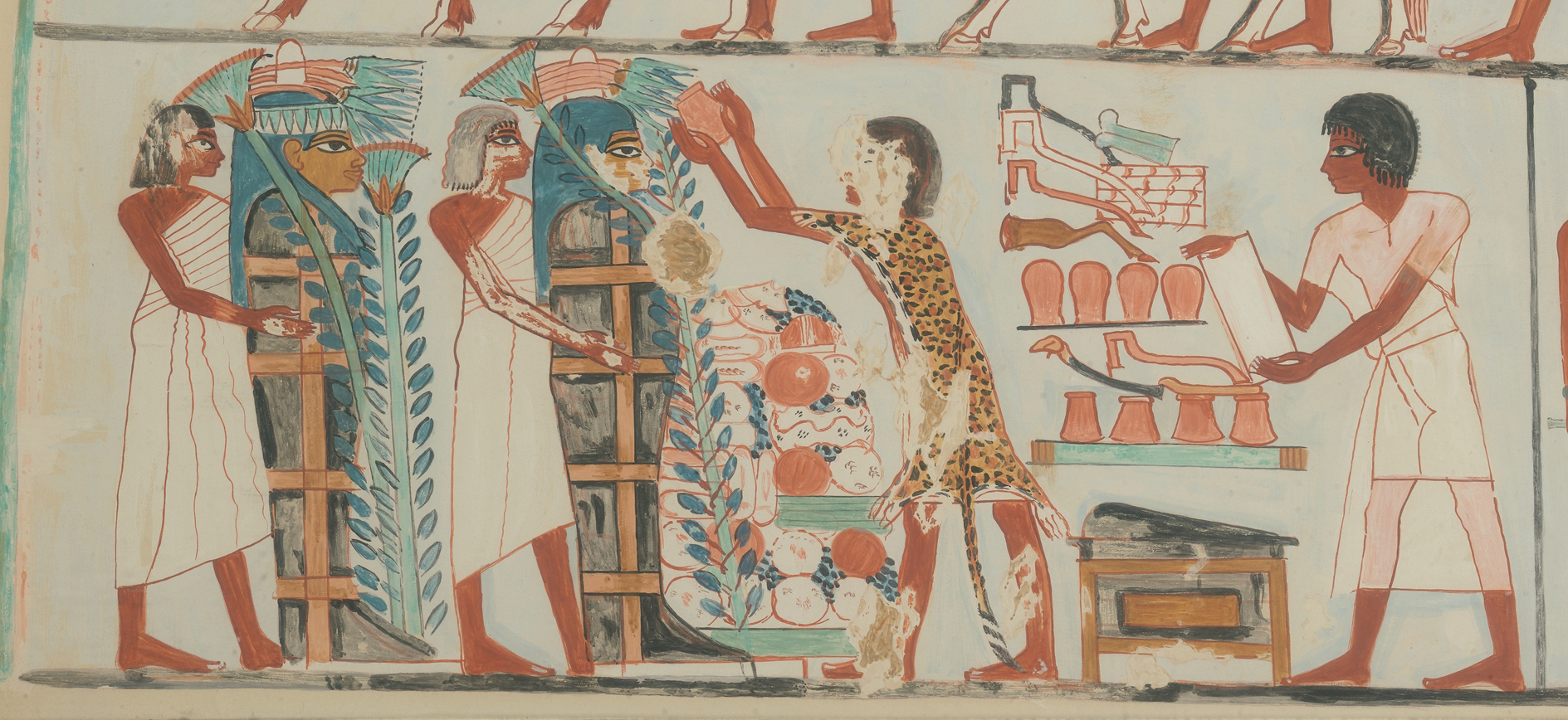
Featured image: Detail from Funeral Procession, Tomb of Pairy, showing funerary rites associated with the Opening of the Mouth. Tempera-on-paper facsimile painted by Nina de Garis Davies in 1935, copying a scene in tomb TT139 at Thebes. The ancient original dates to the reign of Amenhotep III, approximately 1386–1347 BCE according to the museum’s current collection record. The Metropolitan Museum of Art, Rogers Fund, 1935, accession 35.101.3. Image designated Public Domain by the museum. This is a modern facsimile of an ancient representation, not a photograph of the original wall. [13]
What could it mean to become divine?
The expression becoming divine can suggest several outcomes. It might mean acquiring immortality, sharing divine knowledge, joining the company of gods, becoming an effective spirit, or recognising a divine dimension already present. These possibilities should be treated as questions to investigate rather than interchangeable definitions.
Spiritual evolution is even more difficult as a historical category. It can imply an inevitable movement from a lower stage to a higher one, repeated advancement across lifetimes, or the progressive development of humanity as a whole. None of those models should be assumed merely because a text describes an individual transformation.
A return is not necessarily progress towards something unprecedented. Rebirth is not necessarily the continuation of ordinary development. A ritual that restores speech and sight after death addresses a different problem from a dialogue that changes a living student’s understanding.
The interpretation proposed here concerns a change of condition: what prevents the person from participating in a desired form of existence, and what is said to overcome that impediment? The answer may involve ignorance, destructive dispositions, the loss of bodily capacities, exclusion from a community, or several conditions together.
This framing keeps the investigation close to the sources. Instead of asking whether ancient people anticipated a modern theory of spiritual evolution, we can ask what their accounts required a person to become capable of knowing, doing or receiving.
Hermetic rebirth: a living student becomes different
The thirteenth treatise of the Corpus Hermeticum stages a dialogue between Hermes Trismegistus and Tat. Tat asks for the teaching on rebirth, having prepared himself to receive it. Hermes explains the change through images of conception and generation, but the resulting birth belongs to a different order from ordinary bodily reproduction. The discourse describes a person constituted through divine powers. [1]
The transformation also has an ethical vocabulary. The treatise opposes destructive conditions with powers such as knowledge, self-control and justice. As the dialogue proceeds, Tat describes a changed mode of perception. The setting remains a conversation with a living student; the change is not presented simply as something that physical death will accomplish. [1]
The language of birth should therefore not be flattened into a claim about biological alteration. The discourse concerns identity, perception and participation in divine power. Matthew Andrews’s presentation of the treatise draws attention to the contrast between the transformed person’s self-understanding and what remains accessible to ordinary bodily sight. [2]
My reading is that the dialogue distinguishes preparation from transformation. Tat’s desire to learn does not already constitute rebirth, but neither is the eventual change disconnected from preparation. Instruction and a reorientation of the person belong within the narrative that makes the transformation intelligible.
This helps clarify the relationship between knowledge and liberation. Knowledge here is more than possession of a correct description of the cosmos. It concerns the kind of person the student becomes and the dispositions that cease to govern him. Learning that a higher reality exists is not represented as sufficient by itself.
The role of the teacher also prevents an entirely individualistic reading. Tat asks, receives guidance and responds. The discourse makes transformation communicable through a relationship, even where the transformed condition exceeds what ordinary explanation can convey.
Christian H. Bull analyses Hermetic rebirth as a rite of passage and considers the treatise in relation to ritual practice. This is a scholarly reconstruction of the work’s setting and function. It should be distinguished from the directly observable fact that the surviving text represents a transformative encounter between teacher and student. [3]
A literary account may preserve elements of practice, idealise an encounter or guide a reader towards a desired response. Identifying its exact relationship to performed ritual requires more evidence than the presence of a teacher, a student and a declaration of change.
Vision, prayer and resurrection before death
The Hermetic Discourse on the Eighth and Ninth, preserved in Nag Hammadi Codex VI, offers another representation of guided transformation. A student requests advancement through higher levels of understanding. Prayer, praise, silence and visionary language structure the encounter. The speakers describe a change in their relation to divine mind and to one another. [4]
The text matters because it places transformation within actions and exchanges rather than leaving it as a cosmological possibility. The desired result is approached through a sequence. Yet a surviving written sequence does not tell us automatically how often it was performed, by whom, or with what reported effects.
My interpretation is that the discourse presents knowledge as participation. The student does not merely obtain information about a distant realm. Within the literary account, the encounter changes what he can perceive and how he can respond. Prayer and silence belong to that change rather than serving as decorative additions to a philosophical lecture.
This remains a Hermetic work, despite its preservation among texts frequently described together as gnostic. Its manuscript setting does not make its theology identical to every neighbouring composition.
The Gospel of Philip, preserved in Nag Hammadi Codex II, makes a different but related claim about timing. It rejects the expectation that one must first die and only then receive resurrection. The passage at manuscript page 73 presents resurrection as something to receive while alive. Other passages connect transformation with baptism, anointing and the text’s language of mysteries. [5]
This does not permit us to translate resurrection automatically as a modern psychological awakening. The work’s sacramental and theological vocabulary needs to remain part of its interpretation. Nor does its discussion provide a complete, uncontested reconstruction of every associated ceremony.
What the passage does establish is that physical death is not treated as a sufficient mechanism of salvation. The required change has a present dimension. A person’s relation to the promised condition must be established before the event that an ordinary reading might expect to produce it.
My comparative conclusion is that these sources challenge the assumption that postponement equals preparation. Expecting a future transformation and participating in it are not the same thing. This conclusion does not make the Hermetic dialogue and the Gospel of Philip expressions of one doctrine; it identifies a question both raise about the relationship between present practice and future existence.
Egyptian transfiguration: becoming effective after death
Egyptian funerary evidence introduces a different centre of attention. The desired transformation often concerns a deceased person’s capacities, status and relationships beyond death. It should not be treated as a direct description of the living initiate’s experience in a Hermetic dialogue.
Jiří Janák’s study of akh explains the term through a range of connected meanings, including the transfigured or effective deceased. Effectiveness and relationships crossing the boundaries between human and divine, living and dead, are central to the discussion. The term does not have an exact equivalent in a single modern word such as soul or spirit. [6]
This qualification changes the comparison. An akh should not simply be placed at the top of a modern chart of spiritual bodies. The concept concerns what a being can do and how it stands in relation to others, as well as its condition after death.
Mark Smith’s account of Osiris and the deceased provides another important distinction. Restoration has bodily and social dimensions: reconstitution is associated with justification and renewed standing. The deceased’s Osirian relationship also situates that person within a divine community. [7]
My interpretation is that transformation in this setting cannot be described adequately as private consciousness escaping matter. Restored faculties and recognised belonging are part of the desired outcome. The person is enabled to participate in another form of life, rather than merely informed that such a life exists.
This also qualifies the expression becoming a god. Joining divine company, acquiring an Osirian form and becoming effective do not necessarily erase the deceased’s personal identity or make every participant interchangeable with a named deity. The particular wording and purpose of each source must determine the claim.
The contrast with the preceding texts is productive. A living student’s altered perception and a deceased person’s restored faculties can both be transformative, but they address different obstacles. Their resemblance lies in the movement towards a newly possible condition; their mechanisms and temporal settings remain distinct.
Words, instruments and the restoration of capacities
The Opening of the Mouth ritual provides a concrete connection between descriptions of transformation and material practice. University College London’s presentation brings together textual and pictorial sources extending from the Old Kingdom to the Roman period. The rite concerns the consecration or animation of images and, in funerary settings, capacities required for continued existence, including receiving nourishment, breathing and seeing. [8]
The sources do not preserve one perfectly uniform performance. Different versions contain different selections and sequences of episodes. The extended ritual reconstructed across the evidence is therefore not identical to the contents of every individual tomb scene or manuscript. [8]
This variation matters when making claims about spiritual development. A sequence reconstructed by modern scholarship cannot automatically be treated as the exact curriculum followed by every ancient participant. Neither can the number of episodes be converted into a universal count of spiritual stages.
The Metropolitan Museum’s small stone tray with model equipment, dated approximately 2465–2150 BCE, supplies a material example associated with the rite. It contains model vessels and an implement interpreted in relation to the restoration of the mouth’s capacities. The museum discusses nourishment and purification within the set’s significance. [9]
These are models, not a surviving record of every movement made in a particular ceremony. Their form and grouping nevertheless document material provision for a desired transformation. They show that the aspiration could be expressed through objects designed, selected and placed for that purpose.
My interpretation is that the rite treats transformed existence as a question of capability. The desired condition is described through access to activities, rather than only through an abstract declaration of immortality. The relationship between words and instruments is equally revealing: an object’s presence does not explain its meaning by itself, while a ritual text does not necessarily preserve every practical detail.
Pairy’s tomb: transformation represented as restored participation
A more explicit visual example appears in the tomb of Pairy, TT139, at Thebes. The Metropolitan Museum preserves a facsimile painted by Nina de Garis Davies in 1935, copying an ancient composition from the reign of Amenhotep III. The complete composition places a funeral procession above a sequence of episodes associated with the Opening of the Mouth. [13]
The museum’s interpretation identifies priests working on a statue and on the mummified deceased. At the left of the composition, Pairy and his wife stand in mummified form before the tomb. One priest reads from a papyrus beside ritual supplies, while another performs purification with water. The larger sequence includes the application of implements and offerings to restore the ability to see and eat in the afterlife. [13]
The distinction between the ancient scene and its modern copy matters. The facsimile documents the recorded appearance of a particular representation. It is neither the original wall painting nor an independent eyewitness record of the funeral itself. Its evidential value depends on its relationship to the named tomb and on the documentation of the copying project.
My conclusion from this example is that, in this funerary context, transformation was represented as restored participation. Reading, purification, instruments, food and embodied figures form a practical setting for the desired change. The deceased is prepared to perceive and receive, while other people act to enable that condition.
This provides a useful qualification to the metaphor of passing behind a veil. A modern reader might imagine transformation primarily as leaving an apparent world behind. Pairy’s scene instead directs attention towards the capacities through which continued existence becomes possible. The comparison does not invalidate the metaphor, but it limits its historical reach: this Egyptian representation does not establish that the material world was considered an illusion from which the deceased had to escape.
The scene also sharpens the distinction between belief and demonstrated outcome. It is evidence that the restoration of capacities was represented and ritually pursued. It cannot independently establish that the deceased attained the promised condition. Its historical significance lies in showing how that possibility was organised into recognisable actions, relationships and material provisions.
Judgment, protection and the difficulty of moral progress
Nauny’s Book of the Dead, approximately 1050 BCE, makes several aspects of transformation visible together. Excavated from her burial at Thebes, the papyrus includes a judgment scene in which her heart is weighed against Maat, the embodiment of right order. The favourable outcome is associated with continued existence in Osiris’s company and the restoration of faculties. [10]
The scene connects ethical assessment with an enabled afterlife. It does not merely show an individual travelling upwards through a sequence of cosmic locations. Judgment and the conditions of participation are central.
Another object introduces a necessary complication. The heart scarab of Hatnefer, dated approximately 1491–1473 BCE, bears a text intended to prevent the heart from opposing its owner in the afterlife. The inscription belongs to the practical protection supplied for a favourable judgment. [11]
The comparison should not become an easy opposition between sincere morality and deceptive ritual. The evidence shows ethical claims and protective provisions within a religious setting. Their relationship requires interpretation rather than a modern verdict that one makes the other meaningless.
My inference is that spiritual transformation cannot always be reduced to moral improvement. Conduct may matter, but so can ritual preparation, bodily restoration, protection and a favourable determination of status. Different sources assign these elements different roles.
This makes a stronger historical question possible. Instead of assuming that every elaborate burial reflects a more evolved person, we can ask what the provisions were intended to accomplish and what access to them depended upon. Wealth of equipment and spiritual attainment are not equivalent measurements.
The distinction also protects against reading every favourable funerary image as an independent biography of exemplary conduct. A depiction can present the outcome sought for its owner. Establishing the relationship between that representation and the person’s life requires other evidence.
Can the evidence establish a history of spiritual evolution?
The surviving materials demonstrate change over time, but change is not automatically spiritual progress. New forms of inscription, broader patterns of preservation or different distributions of objects may concern access, patronage, burial practice and the survival of evidence.
Mark Smith’s study of the so-called democratization of the Egyptian afterlife challenges a familiar narrative in which postmortem privileges once confined to royalty became available to others in a single major transition. His argument shows why changes in the visible distribution of texts should not be treated as transparent evidence for a corresponding change in who could possess a blessed afterlife. [12]
The methodological implication extends beyond that particular debate. A claim that humanity gradually acquired a higher spiritual capacity requires evidence different from a claim that more people gained access to a particular kind of decorated coffin.
My interpretation is that at least three histories must be kept separate: the history of teachings about transformation, the history of access to practices and resources, and the history of the experiences people reported. They can affect one another, but one cannot simply substitute for another.
The geographical connection also needs care. Hermetic works developed within a Graeco-Egyptian environment, and Bull investigates their relationship with Egyptian priestly traditions. [3] That setting makes historical connections worth examining. It does not mean that a much earlier funerary instrument independently proves the performance of the rebirth described in Corpus Hermeticum XIII.
A persuasive argument for continuity needs particular links: vocabulary, actions, institutional settings, identifiable adaptations or other evidence that explains the relationship. The shared language of birth or light is a starting point for investigation, not its conclusion.
What material evidence can establish
A manuscript preserves an account that someone copied and transmitted. An inscribed object combines a physical form with words directed towards an intended effect. An excavated assemblage can show which things were placed together, where and in what relationship to a burial or building. A documented facsimile preserves a modern record of an ancient image, with its own history of selection and copying.
These forms of evidence support substantial historical conclusions. They can establish that transformation was taught, represented and materially prepared for. Depending on the evidence, they may also help reconstruct particular actions, investment of resources and patterns of access.
They do not all support the same claims with equal strength. A prescribed action is not automatically proof that it was performed on every intended occasion. An object’s conventional identification does not replace examination of its context. A first-person statement in a dialogue is not necessarily an unedited report of one identifiable person’s experience.
The Hermetic texts illustrate this last point especially well. Tat’s statements are evidence for a represented transformation and for what the work makes available to its readers. Interpreting them as traces of performed practice is a further argument, of the kind explored by Bull. [3]
The limits also operate in the other direction. The absence of a distinctive instrument cannot disprove a practice conducted primarily through speech, silence or attention. An experience need not leave a unique archaeological signature. Historical caution requires proportionate conclusions from both presence and absence.
The question of supernatural efficacy therefore remains separate from the identification of a historical practice. Archaeology can investigate the material commitments through which people pursued transformation without independently deciding whether the promised form of existence was attained.
A comparative synthesis: transformation as a change in what is possible
The synthesis proposed here is that the selected traditions can be compared through four questions. What can the person know? What dispositions govern the person? What can the person do or receive? To whom, or to what order, does the person belong?
These questions describe dimensions of transformation rather than successive universal stages. A source may emphasise one, connect several or leave another unspecified. Their usefulness lies in preventing a single word such as awakening from doing all the explanatory work.
In the Hermetic rebirth dialogue, understanding and disposition are central, while the teacher–student encounter gives the change a relational setting. In the Gospel of Philip, receiving resurrection during life is associated with a theological and sacramental account. In the Egyptian examples, restored capacities, judgment and recognised participation after death are especially prominent.
My first conclusion is that higher origin and realised condition should be distinguished. A text may grant humanity a divine relationship while still requiring a process through which that relationship becomes effective. Possibility does not remove the work of transformation.
The second conclusion is that remembrance and change need not be opposites. Recognising an origin can require a change in conduct, perception or affiliation. A return can therefore restore a relationship without simply restoring every feature of the previous condition.
The third conclusion concerns other people. The examples examined repeatedly involve teachers, ritual practitioners, those who provide materials, or authorities who recognise a status. Pairy’s funerary scene makes this relational dimension particularly visible. Transformation can be represented as intimate and profound while still depending on relationships. The modern image of a solitary individual escaping by private insight does not encompass all the evidence.
A final conclusion returns to the question of a reality beyond the familiar world. Passing beyond a boundary is not necessarily the same as acquiring power over everyone below it. Nor must every transformation be understood as departure from embodied existence. The desired change may concern freedom from particular constraints, participation in another community, restored capacities or a changed relation to divine mind. These are distinct claims about what becomes possible.
For these sources, becoming divine is therefore a question that must be broken into precise historical problems. What changed, when did it change, who enabled it and how was the result recognised? Texts and objects preserve different parts of the answers. Their comparison reveals no single ancient programme of inevitable human evolution, but several demanding accounts of how the present condition might cease to be the final measure of human possibility.
Selected Sources and Further Reading
- [1] Corpus Hermeticum XIII, especially sections 1–3, 7–14 and the concluding hymn. In Copenhaver, Brian P., Hermetica: The Greek Corpus Hermeticum and the Latin Asclepius in a New English Translation, with Notes and Introduction. Cambridge University Press, 1992, pp. 49–54. Primary literary source in modern translation for the dialogue between Hermes and Tat, rebirth and the transformation of perception and disposition.
- [2] Andrews, Matthew. Corpus Hermeticum XIII. Center for the Study of World Religions, Harvard Divinity School, 7 July 2026. Introduction and translated selections. Used for the discussion of transformed self-perception and its relationship to ordinary bodily sight. This modern presentation is distinguished from the ancient composition itself.
- [3] Bull, Christian H. The Tradition of Hermes Trismegistus: The Egyptian Priestly Figure as a Teacher of Hellenized Wisdom. Brill, 2018. See especially The Ritual of Rebirth and Heavenly Ascent: The Discourse on the Eighth and the Ninth. Scholarly reconstruction of Hermetic practice and its cultural setting, identified here as interpretation rather than an excavation report of a particular initiation.
- [4] The Discourse on the Eighth and Ninth, Nag Hammadi Codex VI,6, 52.1–63.32. Translation by James Brashler, Peter A. Dirkse and Douglas M. Parrott; accessible online rendering. For the scholarly edition, see Parrott, Douglas M., editor, Nag Hammadi Codices V,2–5 and VI with Papyrus Berolinensis 8502,1 and 4, Nag Hammadi Studies 11, Brill, 1979. Used for the represented sequence of instruction, prayer, praise, silence and vision.
- [5] The Gospel of Philip, Nag Hammadi Codex II,3, especially 73.1–8 for receiving resurrection during life. Translation by Wesley W. Isenberg, reproduced from The Nag Hammadi Library in English, edited by James M. Robinson; accessible online rendering. For editions and scholarship on its sacramental language, see NASSCAL, Gospel of Philip. The discussion does not identify all the work’s ritual expressions with one securely reconstructed ceremony.
- [6] Janák, Jiří. Akh. UCLA Encyclopedia of Egyptology, 2013. Peer-reviewed study of effectiveness, transfiguration and relationships across the human, divine, living and deceased spheres. The term is not treated here as an exact equivalent of the modern word soul.
- [7] Smith, Mark. Osiris and the Deceased. UCLA Encyclopedia of Egyptology, 2008. Peer-reviewed analysis of bodily and social restoration, justification and the deceased’s relationship with Osiris. This scholarly analysis informs, but is distinguished from, the comparative framework proposed in this article.
- [8] Digital Egypt for Universities, University College London. The Opening of the Mouth Ritual. Presentation of the rite’s purpose, implements and textual and pictorial sources, including differences between surviving versions. The reconstructed extended sequence is not assumed to occur in full in every individual source.
- [9] The Metropolitan Museum of Art. Model of the Opening of the Mouth Ritual Equipment, accession 07.228.117a–h. Old Kingdom, approximately 2465–2150 BCE. Rogers Fund, 1907. Collection record for the model tray, vessels and implement. These objects are treated as material evidence of provision for a ritual, rather than independent proof of its supernatural efficacy.
- [10] The Metropolitan Museum of Art. Book of the Dead for the Chantress of Amun, Nauny, accession 30.3.31. Approximately 1050 BCE. Excavated at Thebes, Deir el-Bahri, in Nauny’s burial, 1928–29. Collection record and interpretation of the judgment scene, restored faculties and favourable afterlife.
- [11] The Metropolitan Museum of Art. Heart Scarab of Hatnefer, accession 36.3.2. New Kingdom, approximately 1491–1473 BCE. Collection record for the amulet and its protective inscription addressing the heart. Used to complicate an interpretation of transformation based solely on moral improvement, without assuming that protection and ethical judgment were mutually exclusive.
- [12] Smith, Mark. Democratization of the Afterlife. UCLA Encyclopedia of Egyptology, 2009. Peer-reviewed critique of a familiar model of religious change in Egypt. Used to distinguish changes in the distribution and preservation of funerary texts from claims about access to a blessed afterlife or humanity’s spiritual development.
- [13] The Metropolitan Museum of Art. Funeral Procession, Tomb of Pairy, accession 35.101.3. Tempera-on-paper facsimile by Nina de Garis Davies, painted in 1935; Rogers Fund, 1935. Ancient original: Thebes, tomb TT139, reign of Amenhotep III, approximately 1386–1347 BCE according to the current collection record. See also Patch, Diana Craig, Transforming the Dead, The Metropolitan Museum of Art, Egyptian Art Facsimile Rotation, 2014, printed p. 6, for the scene’s interpretation and the facsimile’s production date. The 2014 catalogue uses the alternative regnal dates approximately 1390–1352 BCE. Featured image: detail of the facsimile, designated Public Domain by the museum.