A Bag of Charms in Pompeii: What a Broken Cupboard Preserved
The cloth bag had broken. Inside a large wooden cupboard in Pompeii, a collapsing shelf sent its contents sliding towards the back of the furniture. Small pendants fell across different levels; some shifted again as volcanic material entered the damaged structure. Among them were miniature hands and feet, divine figures and objects carved from bone. Excavators recovered twenty-four perforated pieces, together with traces of the fabric that had once enclosed them.
Published on 29 October 2026, the excavation report places this collection in house IX 11, 7, traditionally called the House of Cornelius Maximus, on Via dell’Abbondanza. Nearby were a basket containing thirty-eight bronze coins and a small wooden box holding lead weights. Other material associated with the cupboard included vessels, a bronze lamp and equipment used in grooming or preparing substances for the body.
These discoveries have been presented as the belongings of a woman whose wardrobe remained untouched after the eruption of Vesuvius in 79 CE. The evidence supports a more qualified account. No woman has been identified by name. The cupboard was partly destroyed during the eruption, and later tunnellers disturbed some of its contents. What survives is nevertheless unusually informative: objects still associated with their containers, traces of vanished furniture, and a sequence of destruction that archaeologists can reconstruct.
The cupboard and the tunnel
The house’s familiar name requires caution. Its façade was excavated in 1912, and inscriptions around the entrance encouraged an attribution to Cornelius Maximus. Those inscriptions are no longer visible, and the new report describes the identification as highly doubtful. The name therefore functions as an archaeological address rather than a securely established owner’s identity. It supplies no basis for naming the person who possessed the charms.
Recent investigation took place within a project to stabilise the excavation slopes and improve access around the neighbouring Insula of the Chaste Lovers. Only part of the building has been examined. Some relationships between rooms and adjoining properties remain unresolved, while earlier interventions have damaged portions of the archaeological deposits. This is a partially recovered urban household, with a history extending beyond its burial.
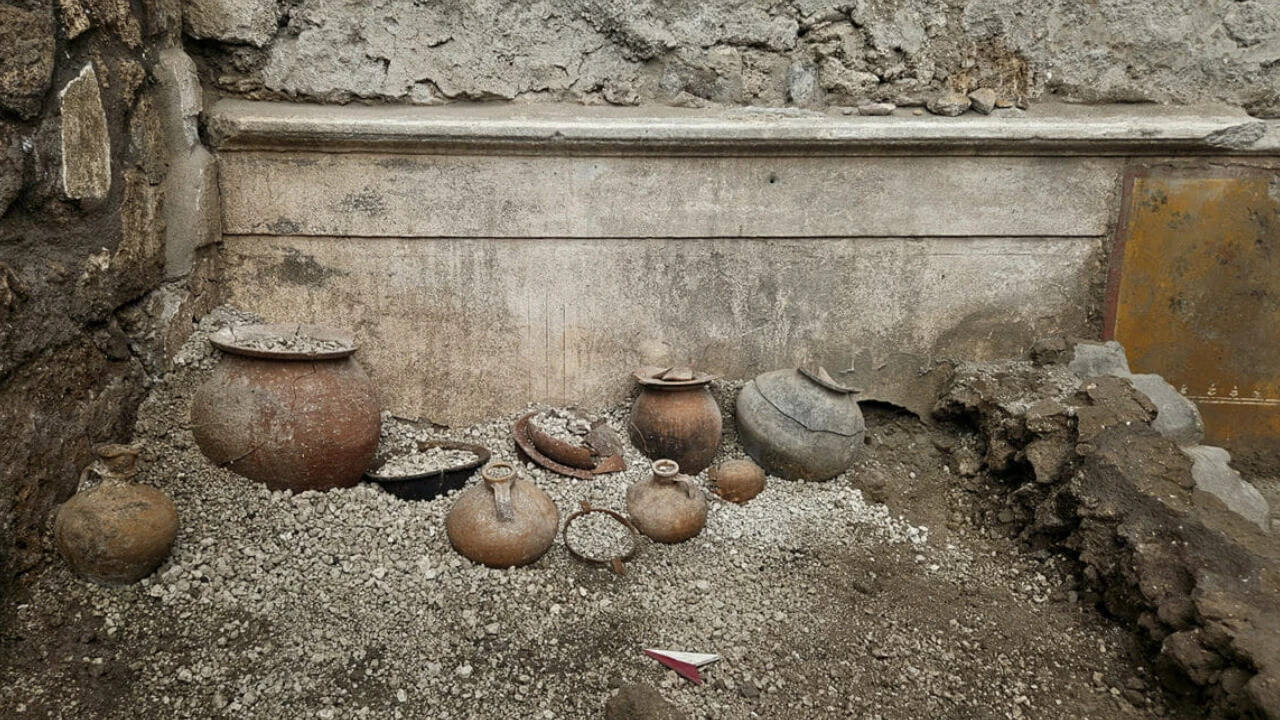
The cupboard occupied the southeastern corner of room B. Its surviving impressions indicate a substantial piece of furniture arranged in two adjoining sections, with internal shelving, a boarded base and iron supports or fastenings. Much of the wood itself had disappeared. Archaeologists reconstructed its arrangement from the spaces and impressions left in the volcanic deposit, alongside surviving structural elements.
The eruption did not preserve that arrangement without movement. Falling roof material smashed the upper part of the cupboard. A pyroclastic current, a moving mixture of hot volcanic particles and gas, entered the room and penetrated the broken furniture. Shelves collapsed, vessels broke, and the bag of pendants slipped and tore. The deposit records a sequence of impacts and displacement rather than a single arrested instant.
There was further disturbance after burial. Excavators identified two human-made tunnels whose dates cannot be securely established. One crossed room B and reached its eastern wall, churning the volcanic fill in the centre while leaving material around the edges comparatively intact. Bronze vessels and other objects were found along its course. The report suggests that earlier diggers had moved some cupboard contents aside, perhaps intending to retrieve them later.
This distinction governs how the finds should be read. The southern section retained the strongest evidence for original storage, including the weights and coin basket. Objects displaced into a tunnel cannot be assigned equally precise positions. The charms themselves retained traces of their bag, but their distribution also reflected the cupboard’s collapse. Describing the whole assemblage as untouched obscures the excavation’s most useful achievement: distinguishing what remained in place from what had moved, and explaining how.
Childhood objects, adult possessions?
The miniature objects were made from faience, bone, glass paste and rock crystal. The excavators recognised Bes and Mercury, anatomical forms including hands and feet, vegetal shapes interpreted as pine cones or grape clusters, beads and an astragalus, or knucklebone. Every piece had a suspension hole. These features support the interpretation of a collection intended to be worn, probably as a necklace, although a complete original stringing arrangement has not been demonstrated.
The report identifies the group as crepundia, a Latin category associated with small childhood objects, ornaments and amulets. The term relates to making a noise, but its archaeological interest extends beyond rattling. Such objects could combine play, bodily protection and personal recognition. Calling a pendant apotropaic means that it was understood to ward off harmful influences; it does not identify a single ritual or establish precisely what its wearer believed.
Here the familiar opposition between jewellery and magic is unhelpful. An ornament could be attractive, protective and personally important at the same time. The presence of Bes or a miniature anatomical form does not establish that its owner practised spells professionally. Conversely, recognising the objects as childhood ornaments does not remove their protective associations. The same object could acquire different meanings as it passed through a person’s life.
The report draws on Roman comedy, particularly Plautus’ Rudens, in which preserved objects help establish a young woman’s family identity. Such stories show that audiences could understand small possessions as material links to a disrupted childhood. They do not prove that every archaeological group of pendants belonged to an abandoned child, or that adults routinely preserved their earliest belongings. A theatrical recognition scene is evidence for a culturally intelligible idea, not a statistical account of household behaviour.
Archaeological comparisons make the keepsake interpretation more persuasive. The authors cite a group of amulets from a cupboard in the House of Helvius Severus at Pompeii, including bone pendants and beads in several materials. They also discuss an adult cremation burial at Porta Nocera containing small ornaments. These comparisons support the possibility that objects associated with childhood could remain meaningful in adulthood. They cannot establish the biography of the newly excavated collection.
A further comparison comes from the House of the Garden, where a wooden box contained ornaments, gems and protective objects. The park’s 2019 account of that discovery described an assemblage combining personal adornment with protection against misfortune. Such finds give the new bag a recognisable domestic setting. Small amulets were possessions that people gathered and stored, sometimes alongside equipment concerned with the body.
Keeping the pendants together in fabric suggests deliberate care. Whether they were childhood keepsakes, ornaments still occasionally worn, belongings held for another household member, or a collection with several histories remains unresolved. Storage is observable; lifelong attachment is an interpretation. Its plausibility should not be mistaken for proof.
Whose belongings were these?
The proposed connection with a woman rests partly on the grooming equipment: bronze tweezers, a glass unguent bottle and a slate coticula, a small slab used for preparing substances. The detailed report notes that such equipment could serve medicinal as well as cosmetic purposes. It describes the association with women cautiously. The slate object, in particular, should not simply become a cosmetic pestle in retelling.
These finds make personal care a reasonable part of the cupboard’s interpretation. They do not determine the sex, legal status or occupation of everyone who used it. A domestic storage unit could contain possessions belonging to several people, together with equipment used on other household members. Nor does the presence of weights establish that a woman independently conducted a business from this room, although that remains a possible explanation.
This difficulty belongs to a wider problem in household archaeology. Penelope Allison’s research on Pompeian house contents examined artefact distributions to reassess room use and living conditions, questioning interpretations dominated by architecture and ancient terminology. An attractively decorated room need not have had one exclusive purpose. Objects can reveal activities that a room’s conventional label conceals, but their presence must also be assessed for storage, displacement and changing use.
The new cupboard adds a closely documented example. Equipment for personal care occurred within an assemblage that also included cooking and serving vessels, money and weighing equipment. That mixture may reflect the practical organisation of a household whose activities overlapped. It may also reflect temporary arrangements: the building was undergoing work when Vesuvius erupted.
The wall paintings complicate any simple social portrait. Their Fourth Style decoration has been attributed through stylistic comparison to the workshop of Via di Castricio. Birds, vegetal ornament and other painted motifs demonstrate investment in the appearance of domestic space. They cannot establish the occupants’ wealth or status on their own. Decoration might have outlasted the circumstances in which it was commissioned, and the excavated portion does not represent the entire property.
Small money and fragile containers
The coin deposit provides firmer evidence for one act of storage. Thirty-eight bronze coins had been placed together in a woven plant-fibre container. Thirty-six were issues of Nero, dated in the report to approximately 64–67 CE; the other two were older and heavily worn. The excavators interpret the group as a modest reserve, perhaps for everyday expenditure.
That is a reasonable reading, although its precise purpose is unknown. Money kept near weighing equipment could relate to transactions, household purchases or several uses in succession. The eight lead weights, stored in their own wooden box, indicate organised keeping of equipment. Their presence alone does not identify a commodity, establish the scale of trade or distinguish a household account from a commercial one.
The coins’ dates also illustrate a basic chronological distinction. Their minting predates the eruption, but does not date the moment when they entered the basket. Coins could circulate for years. The destruction deposit supplies the endpoint for this storage arrangement, while the objects within it carry earlier histories of manufacture and use.
The basket is especially valuable because containers of this kind often vanish while their contents survive. Its fragile remains were transferred to the park’s Laboratory of Applied Research without preliminary consolidation, preserving their potential for analysis. Observation under an optical stereomicroscope revealed plant anatomy attributable to a monocotyledon, the broad botanical group that includes grasses.
Comparison with known basketry suggested a possible identification as esparto-type material. The report presents that identification tentatively, rather than as a securely determined plant species. The surviving construction appeared compatible with an orthogonal weave, in which elements cross at right angles. Even a small remnant can therefore distinguish a woven receptacle from an unexplained cluster of coins.
The bag received similarly careful treatment. Sediment preserving textile traces was sampled for specialist examination. Multifocus stereomicroscope photography revealed a regular woven structure with spacing estimated at about one millimetre. At this stage, the report does not establish the fibre or the textile’s place of manufacture. The method reveals construction more securely than provenance.
These modest observations are essential to the interpretation. Without the basket, there would be coins found together. Without textile traces, there would be a concentration of pendants. Recognising their containers provides stronger evidence that these were deliberately assembled groups before the eruption disrupted them.
A household beyond its human occupants
An amphora from a mezzanine in the adjoining room B1 contained another kind of evidence: 117 small rodent bone remains, representing at least two individuals. Morphological examination supported identification as Apodemus, with the wood mouse, Apodemus sylvaticus, considered the most likely species. Skeletal development suggested animals that were not fully mature.
The identification came from anatomical comparison, not genetic testing. Nor could the researchers securely reconstruct why the animals entered the vessel or how they died. Accidental entry and attraction to organic residues are possibilities. The bones do not establish a major infestation, identify what the amphora last contained, or demonstrate any particular disease risk.
Their recovery nevertheless broadens the household account. Above or beside painted living spaces were stored vessels and small animals exploiting the built environment. Together with construction work and crowded storage, this evidence describes a property in use and alteration. The cupboard’s arrangement may belong to that particular phase rather than represent an enduring pattern of domestic organisation.
The abandonment of the coins and charms cannot resolve the fate of the occupants. People might have died, escaped without returning, been absent already, or found recovery impractical. Later tunnelling demonstrates intervention in the buried building, but does not identify those responsible. Unrecovered property cannot by itself supply a casualty list.
The strongest conclusion is narrower and more useful. In one partly excavated Pompeian house, people stored weighing equipment, a small monetary reserve and a fabric-contained collection of miniature ornaments within a substantial cupboard. Some objects retained their associations despite collapse and later disturbance. The charms plausibly carried protective and biographical meanings, but the person who assembled or inherited them remains unknown. The unresolved question is how that collection moved through a household before it reached the shelf: as something still worn, something held for a child, or something kept from an earlier life.
Selected Sources and Further Reading
- Zuchtriegel, Gabriel; Comegna, Chiara; De Rosa, Saverio; Esposito, Domenico; Naime, Younes; Scarpati, Giuseppe; and Trapani, Ausilia. 2026. Lo scavo di una domus nell’insula IX 11: il rinvenimento di un armarium con crepundia. E-Journal degli Scavi di Pompei, no. 11, 29 October. Primary excavation report, including the furniture, disturbance, coins, basketry, textile traces and faunal analysis.
- Allison, Penelope M. 1995. House Contents in Pompeii: Data Collection and Interpretative Procedures for a Reappraisal of Roman Domestic Life and Site Formation Processes. Journal of European Archaeology 3(1): 145–176.
- Allison, Penelope M. 2004. Pompeian Households: An Analysis of the Material Culture. Los Angeles: Cotsen Institute of Archaeology, University of California. Further reading on household assemblages and domestic space.
- Parco Archeologico di Pompei. 2019. The luck and the protection against the bad fate in the jewelery of Regio V. Institutional account, 12 August, of the ornaments and amulets from the House of the Garden.